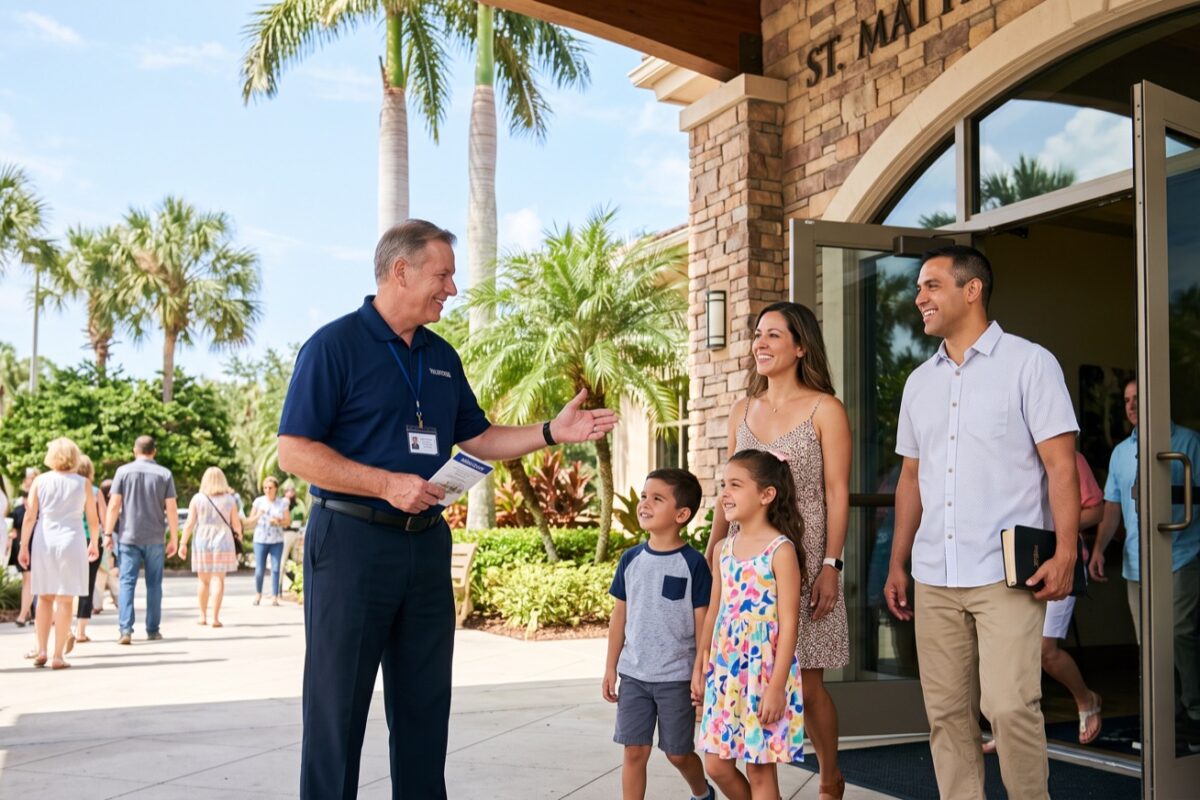
Timeline of employee termination security in Florida in five steps, from choosing the officer's role to the days after, with the Florida statute that applies at each step.

How to Plan Employee Termination Security in Florida

If you have decided to let an employee go and the way they have behaved makes you unsure how they will take the news, decide who will be in the room and how the person will leave before you set a date for the meeting. Kathleen Bonczyk, founder of the nonprofit Workplace Violence Prevention Institute, told CNN in 2019 that "the point of termination is perhaps the greatest opportunity for deadly workplace violence." Employee termination security means a licensed officer at a termination: in the room, delivering the decision for you, or escorting the person out. ESS Global is a Florida security agency in Tarpon Springs, licensed as agency B 1200075, and we provide officers for terminations across Tampa Bay. This guide covers how to know whether a termination needs an officer, which role to book, what Florida law says about the exit and the parking lot, and what to set up for the days after.

Deciding on employee termination security

OSHA has no workplace violence standard, and no specific rule requires a threat assessment as part of a termination plan. OSHA's general duty clause still requires employers to keep the workplace free of hazards likely to cause death or serious harm. If you are concerned about threats to your whole building or site, our threat and vulnerability assessment works out who is likely to pose a threat and where your building and your procedures are weak, and ends in a written report with recommended actions. If you only suspect the employee, for example of stealing inventory or of filing a workers' comp claim their social media contradicts, ESS can have licensed investigative partners look into it first. Our guide to when Florida businesses need a private investigator explains how a workplace investigation runs and what is in the written report at the end.

Jeff Sweetin, a corporate security consultant who spoke at SHRM's 2018 annual conference, named abusive language and violent gestures among the obvious warning signs, and said managers and co-workers sometimes ignore odd behavior because they are used to it. Bonczyk told CNN that the most dangerous firings can be of employees who have been there a long time. Steve Albrecht, a threat assessment expert and co-author of "Ticking Bombs: Defusing Violence in the Workplace," told CNN that companies should not assume an employee would never turn violent just because they have no criminal record. Marc McElhaney, a psychologist whose firm helps companies separate high-risk workers safely, advises getting the managers who know the employee together and comparing what each of them has seen, because in one of his cases no one person in the company knew everything the employee was dealing with. Write those observations down and bring the list when you book an officer.

Take the same precautions with every termination: have a second manager and security in the room. If you think the person may react violently and your building has no security staff of its own, hire an officer for the termination. Sweetin says to meet with your lawyer and your security staff together once you have assessed the threat. Once you have decided, he says to do it quickly, and Albrecht says not to warn the employee that it is coming.

Choose the officer's role

Role we staff What our officer does What it is for
In the room Sits in on the termination meeting and watches for signs of escalating behavior An officer the employee can see, which often deters confrontation
Facilitated termination Represents you in the room, tells the employee the termination decision and manages the process Terminations where you already expect hostility, or where executives want more protection and discretion
Escort and exit Walks the former employee off the premises, to their vehicle or to another place you name Protecting company property and keeping work going while the person leaves

Albrecht told CNN that the sight of a uniformed guard "raises the emotional temperature of the employee being terminated," and that it is better to have an armed guard nearby, outside the door or listening in, with a code word for when to come in, or to have security in plain clothes in the room. Sweetin told the SHRM conference to have security officers present but keep them low-profile. Section 493.6305 of the Florida Statutes requires a Class D security officer to work in a uniform with the agency's patch visible at all times. It allows plain clothes only on a limited special assignment, when the duty or the client's special requirements make it necessary. An officer who also holds a Class G firearms license may carry a concealed firearm on that kind of assignment. If you want plain clothes, tell us when you book and give the reason.

Under section 493.6301, a security agency needs a Class B license, and ours is printed in the footer of this site. Every officer needs a Class D license, plus a Class G license if they carry a firearm. The Florida Department of Agriculture and Consumer Services runs a public licensee search, so ask any agency for the names of the officers it will send and look them up. We train our own officers at ESS Academy, which holds Florida Class DS security officer school license DS1400022.

Plan the room, the exit and the parking lot

Sweetin says to keep the meeting short and not argue, and to limit the employee's contact with the supervisor and co-workers once the decision is made. If the meeting may turn volatile, hold it in a room near an exit and ask the people who sit nearby to take an early lunch. Sweetin warned against asking a large employee to act as an unofficial "bouncer" instead of using security officers, because that employee is not trained and the company is liable if either of them is hurt in a fight. Before the meeting, list every badge, key, fob and parking permit the person has, and collect them in the room.

If the person needs to collect belongings, have a supervisor and security walk with them to the desk. FindLaw says an employee leaving on good terms can collect their own things, and otherwise warns against "a spectacle of having security march them to their desk with a box." Then walk the person to the door and watch them leave the premises. Officers we send for a termination stay nearby for a short time after the person has gone. Sweetin says to check how the person usually gets home, and to arrange a cab if they carpool.

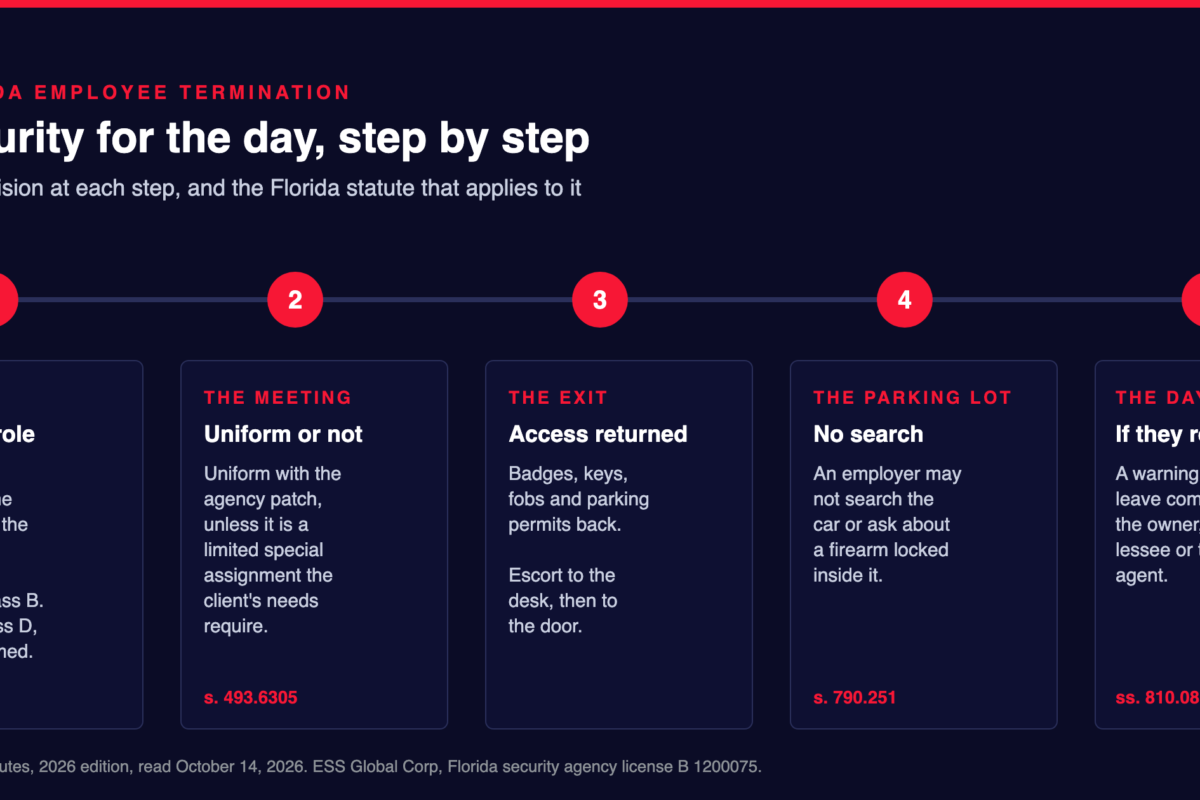
Section 790.251 of the Florida Statutes bars employers from prohibiting any customer, employee or invitee lawfully in the parking lot from keeping a legally owned firearm locked inside, or locked to, their private vehicle. The same section bars employers from asking, out loud or in writing, whether there is a firearm in the vehicle, and from searching the vehicle for one. The statute allows a search of a car in the lot only by on-duty law enforcement acting with due process. The rule has exceptions, including school property, correctional institutions, vehicles the employer owns, and sites involving national defense, aerospace, homeland security or explosives. If one of our officers walks the person to their vehicle or watches the lot, give the officer a description of the person and the vehicle.
Comparison panel under Florida Statutes section 790.251: an employer may not bar a lawfully owned firearm locked in a person's car, ask whether there is one, or search the car. The employer can still have the person escorted to their car, give a description to whoever watches the lot, and arrange how the person gets home.

What a security officer cannot do

Albrecht told CNN that violence after a firing can come within two weeks, while the person is still angry and has time to plan, or around two years later if they have not found a job. If the employee threatened anyone during the meeting, Sweetin says to hire officers to protect your staff afterwards, and we can station armed guards or a dedicated on-site team at your building for those weeks, around the clock if you need it. For the same weeks Albrecht says to "listen for the leakage," because people who plot attacks often confide in someone, and to make sure the person's friends at the company feel comfortable reporting threats. McElhaney's warning is that once an employee is fired, "companies don't have a lot of options to deal with him or his behaviors."

Albrecht also told CNN to keep the person on the employee assistance program for a while after the firing. He recommends what he calls a "benevolent severance," such as severance pay or a temporary extension of benefits. In his words, "There's just less animosity, less desire for revenge when you treat people like adults." Settle the severance and benefits before the meeting, and have whoever delivers the decision tell the person in the room.

The days after the termination

If the person comes back, section 810.08 of the Florida Statutes makes it trespass when a person who was once allowed into a building is warned to leave by the owner, the lessee or someone they authorize, and refuses. For open property such as a parking lot, section 810.09 lets you give the warning by telling the person directly. McElhaney cautioned against automatically barring a fired employee from the premises or seeking a restraining order, because it might make the person angrier. Decide case by case, and write down who will give a warning to leave on the company's behalf.

Tell the rest of the staff that the person no longer works for the company, without going into the reasons, and remind them not to share company information with the former employee. Give the receptionist a photo of the person and tell them who to call if the person shows up. FindLaw says to be polite and to call security, or the police if you have no security. If you have booked our guards for the weeks after, they are the security to call.

To book an officer for a termination, call 727-940-7926 (Monday to Friday, 9:00 to 6:00) or email info@essglobalcorp.com. Have the date and time ready, along with the address, the room you plan to use and its nearest exit, how the person gets to and from work, and what has made you concerned. Our corporate termination page describes the service, and the security guard services page covers guards for the weeks after.
Request a free quote

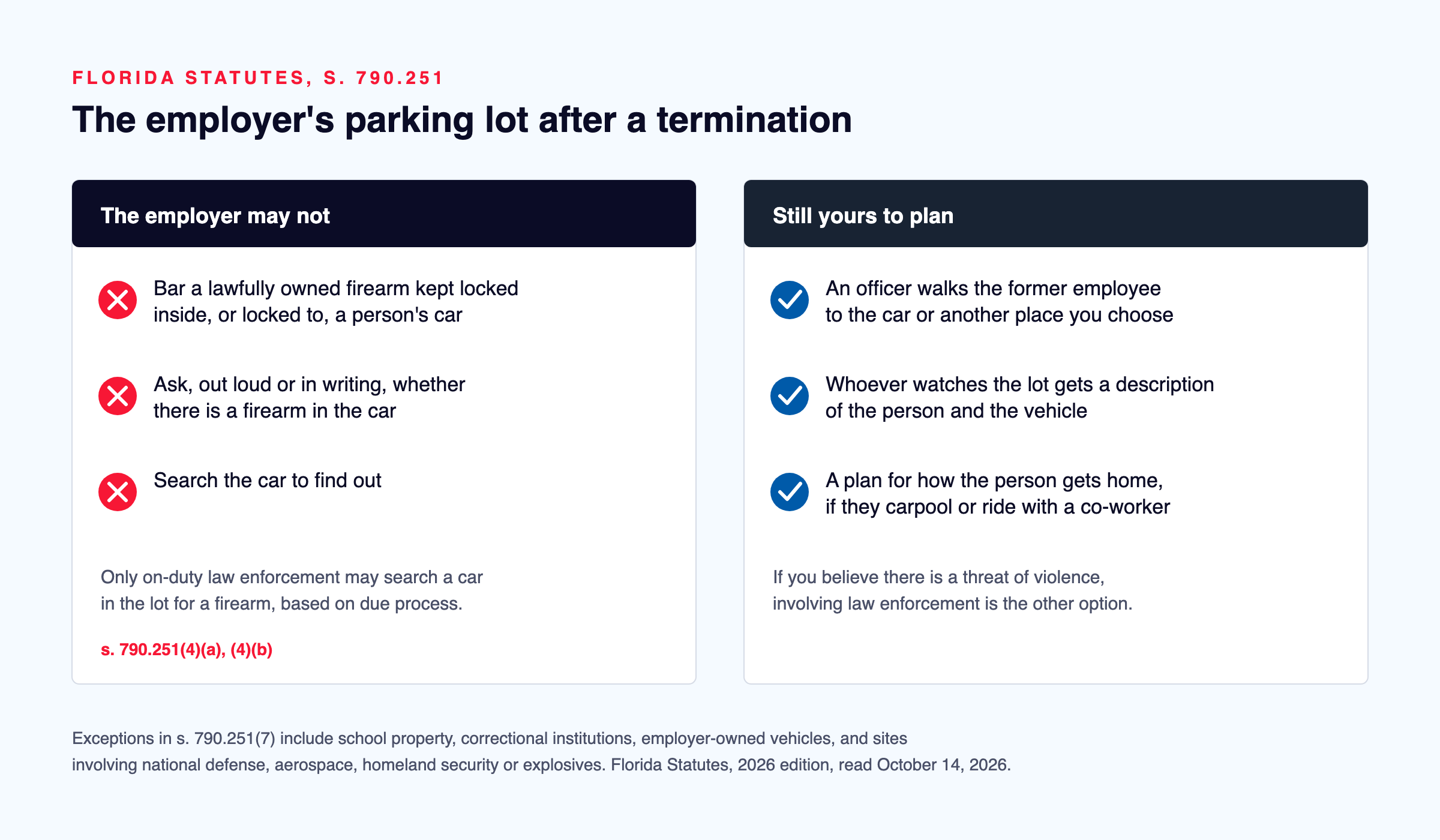
Plan of a gated community showing what HOA security guards do at each place: identification and access checks at the gate, vehicular and foot patrols on the streets, and access checks at the pool and clubhouse on the edge of the property, beside a column listing two things the officers do not do: the board decides fines after notice and a hearing, and a towing company removes cars once the tow-away signs are posted.

Hiring HOA Security Guards in Florida: A Guide for Boards

An HOA board in Florida that wants security guards has to know, before it signs, whether Florida law makes it take competing bids and which rules the officers can enforce on the property. HOA security guards are licensed officers from a Florida security agency, hired by an association to watch its gate and common areas and enforce its rules. ESS Global is a licensed Florida security agency in Tarpon Springs that has protected clients since 2011, and it provides HOA security officers to communities in Tampa, Clearwater and St. Petersburg. This guide covers how to choose the posts, which licenses and insurance to check, what Florida requires of the contract and the bids, what officers can and cannot enforce, and how to get a proposal from ESS.

What HOA security guards do in a community

ESS's 2015 page on apartment, condominium and HOA security lists the services ESS provides to a community, among them gate guards, walking guards and mobile patrols, pool and clubhouse access, identification checks, alarm monitoring and response, parking enforcement and policy enforcement, with complete daily log reports. The same page says ESS officers are present for evictions and for conflict resolution. ESS's current HOA security page offers armed and unarmed officers. It also notes that pools, gyms, spas, parks and playgrounds are often on the edges of a property, where they are harder to supervise. The Crescent Oaks testimonial on ESS's site calls ESS's gate guards courteous and friendly and recommends them "to any HOA looking to improve their community's security services."

Before asking for a proposal, list each place you want an officer and the hours for each one: the gate, the streets at night, the pool and clubhouse while they are open, and the parking lots. ESS's security guard services page offers daytime coverage, after-hours monitoring or full 24/7 protection, and the FAQ says ESS can staff a site with anything from a single officer to a full detail. ESS offers associations a free security analysis. The FAQ says ESS will recommend armed or unarmed officers for each site.

The licenses and insurance to check

Check two kinds of license: the company's Class B agency license, and a Class D for every guard it puts on your property. A Class D takes at least 40 hours of training at a school licensed by the Florida Department of Agriculture and Consumer Services (FDACS). An officer who carries a firearm also needs a Class G, which takes 28 hours of range and classroom training. On duty, the officer must have the license in his or her possession and, except on a limited special assignment, wear a uniform with at least one patch or emblem that identifies the agency. Ask each bidder for its agency license number and the names of the officers it plans to assign, and look up both on FDACS's licensee search, which has one form for individuals and another for agencies and schools.

FDACS will not issue a Class B license until the agency files proof of commercial general liability insurance of at least $300,000 combined single limit, with the department named as an additional insured so that it receives any notice of cancellation. If the policy is cancelled, the agency's license is suspended automatically on the cancellation date unless the agency shows the department new coverage first, so ask each bidder for its certificate of insurance and check that it is current on the day the contract starts. Under that rule, an agency whose Class B license has not been suspended has that coverage on file with FDACS, and ESS's agency license is B 1200075. ESS's FAQ says the company is fully insured and that "our officers are individually licensed by the State of Florida and screened, trained, and supervised by our leadership team." ESS's owner, Theodore Billiris, holds the Class B agency license and his own Class D, both since 2011. ESS trains its officers in-house at ESS Academy, the company's Class DS school (license DS1400022), which teaches the Class D course as 42 hours of instruction in Tarpon Springs or live online, along with the Class G course its armed officers need, and the FAQ says officers finish that training "before stepping on post."

The contract and Florida's bid rule

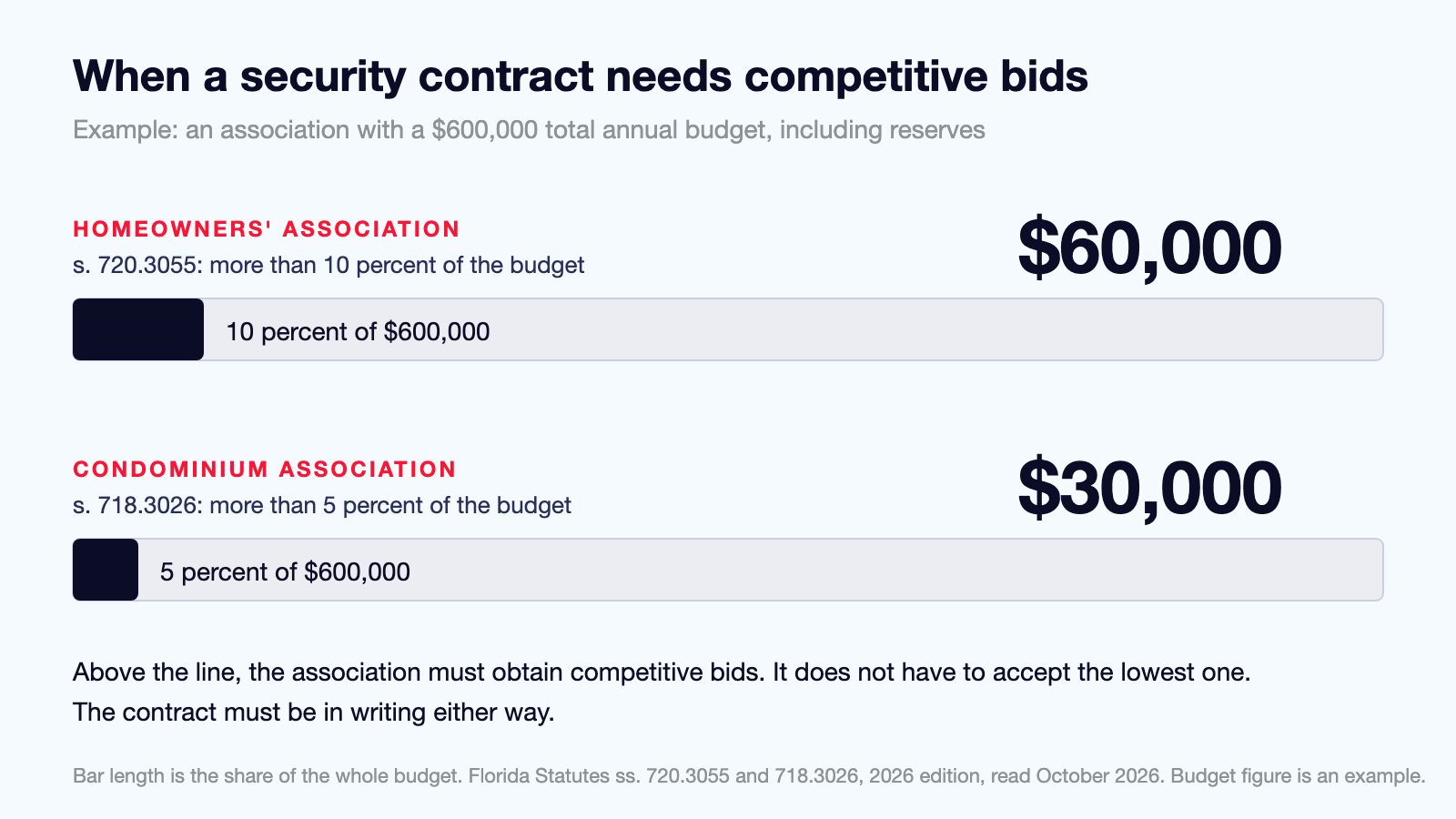
Section 720.3055 requires every contract an HOA signs for services to be in writing. If a security contract requires payment by the association of more than 10 percent of its total annual budget, including reserves, the association must obtain competitive bids, under its own declaration or bylaws if they set a procedure at least as strict. For example, an association whose annual budget is $600,000 including reserves must take bids on a security contract that requires payment of more than $60,000. In an emergency, the association can hire security without taking bids, and ESS's 2015 page says it supplies uniformed officers for emergency and short-term work as well as long-term posts. Condominium associations, which ESS's 2015 page also covers, follow section 718.3026 instead and take bids above 5 percent of the total annual budget including reserves.

Figure comparing Florida's competitive bid lines for a security contract: for a homeowners' association under section 720.3055, 10 percent of the total annual budget including reserves, which is $60,000 on an example budget of $600,000; for a condominium association under section 718.3026, 5 percent, which is $30,000 on the same budget.

Ask every bidder for a separate price on each post; the board does not have to accept the lowest bid. ESS's FAQ says it assesses the location and the hours of coverage before it writes a proposal, and that most written proposals go out within one business day. That proposal, like every bid the association receives, is an official record the association has to keep for one year, and the signed contract is an official record too. A contract awarded through competitive bids can be renewed without new bids if it lets the board cancel on 30 days' notice.

What the officers can and cannot enforce

Under section 810.09, a person who defies an order to leave the grounds, given in person by the owner or by an "authorized person", commits a first-degree misdemeanor. Section 810.08 covers a building such as a clubhouse, where entering or staying without permission is trespass, and so is refusing to leave after a warning from the owner or a person the owner authorizes. Section 810.09 defines an authorized person as the owner, the owner's agent, or a community association authorized as an agent for the owner. ESS's officers can check access and enforce the association's rules on the common areas, but under section 810.09 the order to leave has to come from the owner or an authorized person. If the board wants ESS's officers to give that order, write that authority into the contract.

Under section 720.305 the board can fine an owner up to $100 per violation, and up to $1,000 in total for a continuing violation, unless the governing documents set other limits. No fine or suspension can be imposed until the board gives the owner at least 14 days' written notice of a hearing before a committee of at least three members who are not officers, directors or employees of the association, and the notice must describe the alleged violation. The committee has to hold the hearing within 90 days of the notice, and the fine goes ahead only if a majority of the committee approves it. Ask that the officers' daily logs go to the manager or the board. If the board suspends an owner's use of the common areas, the owner or tenant can still drive or walk through the gate to the parcel and park there.

ESS's officers can enforce parking rules, but only the owner or a person the owner authorizes can have a car towed, and under section 715.07 that person is not liable for the cost of removing or storing a vehicle parked without permission. Unless the driver is told in person, a tow-away sign with the wording and letter sizes the section specifies, and the towing company's name and phone number, has to stand at each driveway entrance for at least 24 hours before any tow. Cities and counties can add their own towing rules to the state's, and a person who has a vehicle towed improperly is liable to its owner for the towing and storage costs, any damages, and attorney's fees and court costs. Check that the signs are up before the board authorizes anyone to call a tow.

Getting a proposal for your community

Call ESS on 727-940-7926 from 9 to 6, Monday to Friday, or send the quote form at any hour. On that call, ask ESS to schedule the security analysis, and have these ready: the annual budget including reserves, the association's rules and parking policy, and the hours you want the gate staffed and the amenities covered. ESS management will also come to a board or committee meeting. ESS's office is at 425 E. Spruce St., Suite A, in Tarpon Springs.

Request a security proposal for your community

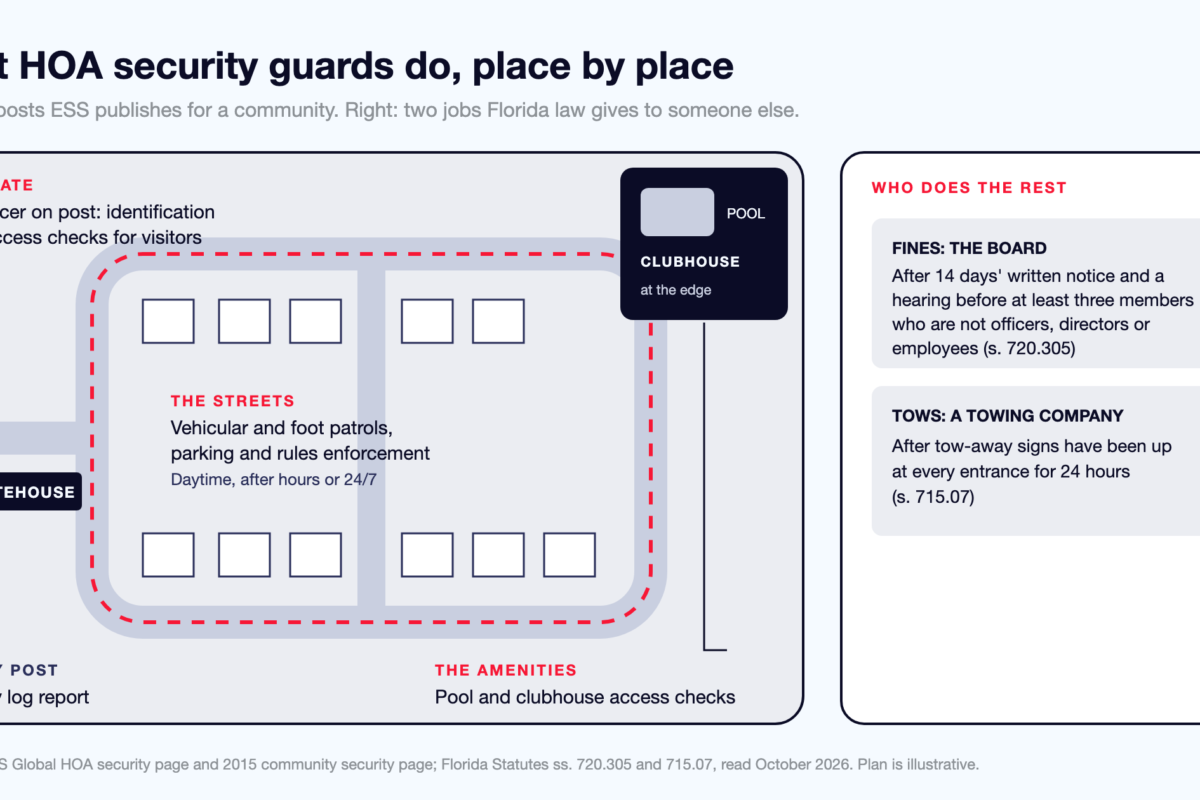
Volunteer security greeter welcoming a family at a Florida church entrance

Church Security Plan for Florida Congregations

A church is supposed to feel open. That is the whole point, and it is also why church security is harder than securing an office or a warehouse. The goal is not to make a congregation feel watched. It is to make sure the people running the service, from the pastor to the nursery volunteers, know what their role is and what to do if something comes up.

This guide is for church leaders in Florida who want a practical starting point. It focuses on planning and routine, not on worst-case scenarios, because the churches that handle problems well are usually the ones that prepared calmly long before anything happened.

Start With How Your Church Actually Runs

Every congregation has a different rhythm. A small neighborhood church with one Sunday service has very different needs than a multi-campus church with children's programs, weekday events, and a large parking lot. Before you buy anything or hire anyone, write down how a normal week works:

  • When the building is open, including services, rehearsals, youth nights, and weekday programs.
  • Who is on site at each of those times, and who is responsible for the building.
  • Where people come and go: main doors, side entrances, the nursery, the office, and the parking areas.
  • What is unique to your church, such as a school on campus, a food pantry, or a bookstore with cash on hand.

Most gaps show up when you compare this list against who is actually paying attention to each area.

The Core Pieces of a Church Security Plan

A workable plan for most congregations comes down to a handful of pieces.

Welcoming, visible entrances

Greeters are your first layer. A friendly person at each main door sees who is arriving, notices anyone who seems out of place, and does it in a way that feels like hospitality. Train greeters on what to notice and who to tell, without turning them into guards.

A defined team with clear roles

A volunteer safety team works best when everyone knows their position and who leads. Decide who watches the sanctuary, who covers the parking lot, who is near the children's areas, and who is the point of contact if something needs attention. Written roles beat good intentions.

Children's areas

Check-in and check-out for nursery and children's programs is one of the most valuable routines a church can have. Matching a child to an authorized adult, every time, protects families and protects your volunteers.

Parking lot and grounds

Many church incidents involve vehicles and parking, not the sanctuary. Lighting, a visible presence before and after services, and attention to cars during the busiest arrival and departure windows all matter. In Florida, afternoon heat and storm season also bring their own considerations for people on the grounds.

A communication plan

Decide how the team talks to each other during a service. Some churches use radios, some use earpieces, some use a simple group text. The tool matters less than the habit: everyone knows how to reach the team lead quickly and quietly.

A response plan for staff

Every church should have a simple written plan for the situations a congregation might face, such as a medical emergency, a disruptive person, a lost child, severe weather, or a fire. Cover where people go, who calls 911, and who stays with whom. Practice it once a year, and keep the drill calm and brief.

Volunteers, Off-Duty Officers, or a Licensed Agency

Most churches use some mix of these three, and the right blend depends on size and budget.

  • Volunteer teams are the backbone of most church security. They know the congregation and cost nothing to staff, but they need training, clear roles, and a leader, and they should not be expected to carry more than they signed up for.
  • Off-duty officers can add a visible presence on busy days, though availability and consistency vary week to week.
  • A licensed security agency provides trained, insured officers on a schedule, which helps for large services, holidays, and special events. It also takes the pressure off volunteers who would rather be worshipping.

Whichever mix you choose, confirm that any paid provider is a licensed, insured Florida security agency, and that armed coverage, if you choose it, is handled by properly licensed officers. Your church insurer may also have opinions, so it is worth a call before you decide.

Training Matters More Than Equipment

It is tempting to start with cameras and door hardware. Those can help, but a plan nobody has practiced tends to fail exactly when it is needed. Training a volunteer team on positions, communication, and a few basic responses does more for a church than a shelf of equipment.

Good training covers:

  • How to read a room and spot someone who needs help or attention
  • How to approach a person calmly and respectfully
  • Where the exits are and who leads people to them
  • Basic first aid and how to handle a medical situation until help arrives
  • When to call 911 and what to say

Training should feel like part of ministry, not a departure from it.

Balance Safety and Welcome

Florida congregations also have a few local factors to fold in: large parking lots that fill quickly, outdoor events during warm months, and the hurricane season calendar, which is worth building into your response plan alongside everything else.

The best church security is nearly invisible to a first-time visitor. They see friendly greeters and a well-organized building. Behind the scenes, a team is paying attention and knows what to do.

If your plan makes visitors feel interrogated, adjust it. If your team is uncomfortable or unsure, that is a sign they need clearer roles and a bit more practice, not more equipment.

A Simple Checklist to Start

If you are not sure where to begin, start here:

  1. Walk the building and grounds during a service and note every entrance.
  2. Write down who covers each area, and where no one does.
  3. Check children's check-in and check-out procedures.
  4. Confirm lighting in the parking lot and at exterior doors.
  5. Decide how the team communicates during a service.
  6. Write a short response plan and share it with staff and team leads.
  7. Schedule a training session and a yearly review.

How ESS Global Helps

ESS Global is a licensed, insured Florida security agency. Our church security work includes training a church's existing staff and volunteers and putting together a security plan tailored to the building and the way the congregation meets. For churches that want to understand their gaps first, a threat and vulnerability assessment gives you a written, prioritized look at your site. We also provide security guard services for larger services and events.

Talk Through Your Church's Plan

If you would like a second set of eyes on your church's plan, call ESS Global at 727-940-7926 or request a quote.