Florida Fire Watch Requirements: When You Need One

Most fire watch calls we get start the same way: a fire alarm panel is showing a fault, a sprinkler contractor just shut a riser down for repairs, or a fire marshal walked a job site and said the word "impairment." Whoever made the call usually doesn't know yet whether they legally need a fire watch, how fast one has to start, or who's allowed to run it. This is the short version.

What Actually Triggers a Fire Watch in Florida

Florida enforces fire safety through the Florida Fire Prevention Code, which adopts NFPA 1 and NFPA 101. Under those codes, a fire watch gets triggered when a building's fire protection can't do its job for a period of time. The situations we see most often:

  • Fire alarm system impairment. If a required fire alarm system is out of service, the authority having jurisdiction (AHJ), meaning the local fire marshal or fire department, generally expects notification, and a fire watch is one of the accepted ways to keep the building occupied while it's down. A common threshold you'll hear cited is impairment lasting 4 hours or more in a 24-hour period, though the exact call is the AHJ's.
  • Sprinkler or standpipe system out of service. Same logic: if the water-based suppression system a building depends on isn't working, whoever has jurisdiction can require continuous, documented patrols until it's restored.
  • Hot work. Welding, cutting, or grinding, especially on active job sites, routinely requires a fire watch during the work and for a period afterward as part of the hot work permit.
  • Overcrowding or blocked egress at an event. Venues that exceed occupancy limits or have compromised exits can be required to post a fire watch until the condition is fixed.
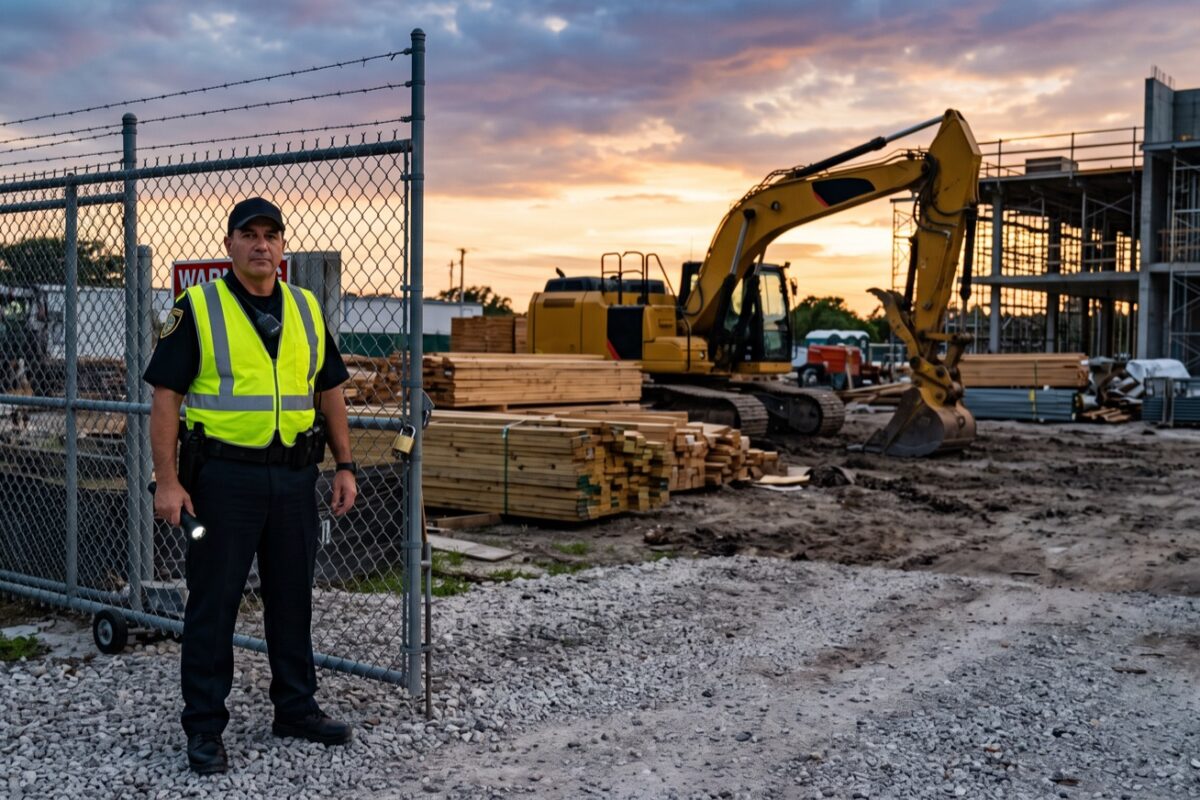
  • Active construction and demolition. Standpipes aren't always live yet, fire separations are incomplete, and there's more combustible material on site than the finished building will ever have again. Fire marshals treat active construction differently than an occupied, code-compliant building.

None of this is one-size-fits-all. The code gives the AHJ latitude to decide whether a fire watch, an evacuation, or another compensating measure fits the situation, so the fastest way to get a straight answer is a call to your local fire marshal's office, not a guess.

Who's Actually Allowed to Run One

A fire watch is a security function, not a favor from whoever's on site that day. It needs to be performed by trained personnel from a licensed, insured security agency, someone who knows what they're watching for and can produce a defensible log if the AHJ asks for one later. We hold Florida security agency license #B12000275 and run fire watch as one of our core fire watch services, separate from general patrol work.

That distinction matters more than it sounds. An unlicensed guard standing near a panel isn't a fire watch. If the AHJ finds out the personnel weren't qualified, the building can end up right back where it started, out of compliance, except now with less goodwill from the inspector.

What a Fire Watch Actually Looks Like On Site

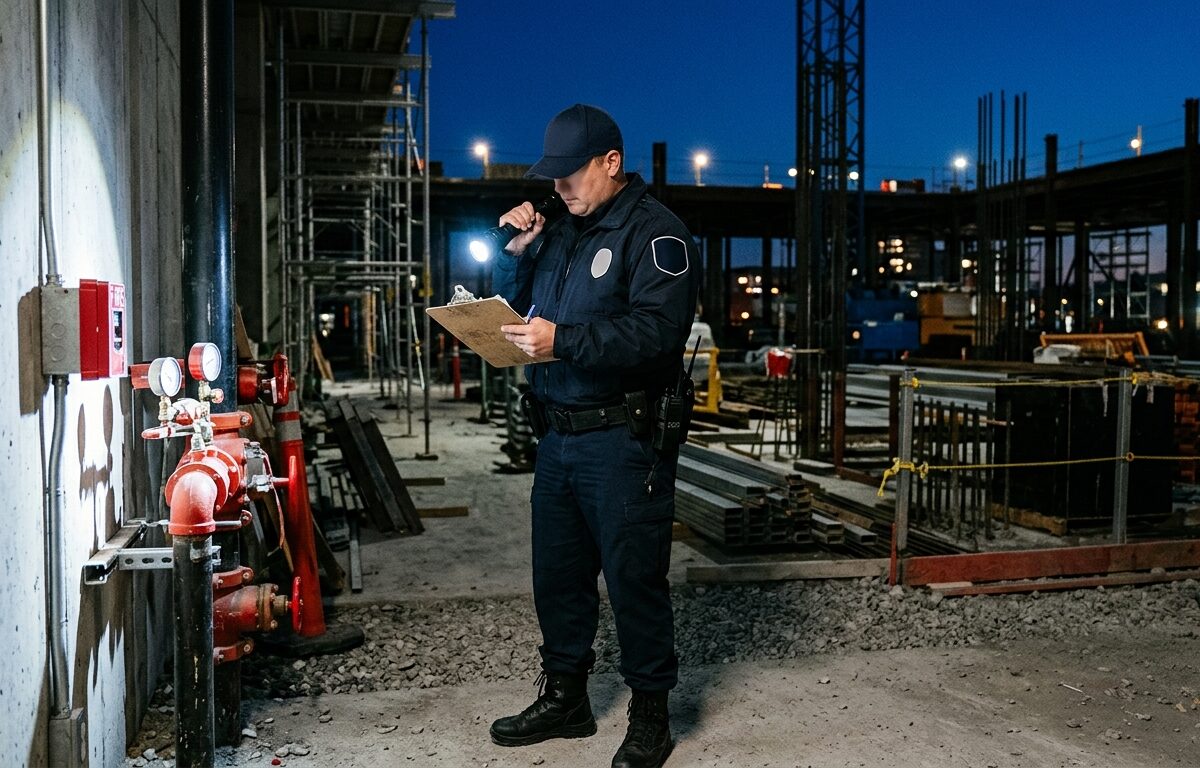
A real fire watch isn't someone sitting in a chair. It's a continuous, documented patrol built around the specific hazard the AHJ flagged:

  • Regular rounds. Route and frequency come from the approved fire watch plan, but 15 to 30 minute rounds are typical for most impairment situations.
  • A hazard-specific checklist. Watching the area around the impaired system, checking for ignition sources, confirming exits stay clear, and knowing where the nearest working extinguishers and pull stations are.
  • A written log. Time-stamped entries for every round, plus anything unusual, are what the AHJ actually wants to see if they follow up. No log means no proof the watch happened.
  • A direct line to the fire department. If something does go wrong, the person on watch needs a way to notify the fire department immediately, not after finding a supervisor first.

What Happens If You Skip It

Running a building or job site without a required fire watch isn't a paperwork problem, it's the AHJ's call on whether the space is safe to occupy at all. Depending on the situation, they can require the space evacuated, work stopped, or the building closed until the impaired system is restored or a compliant fire watch is in place. On an active construction site, that can mean a shut-down crew standing around waiting on a security decision instead of working. A fire watch is almost always the cheaper option once you account for the cost of downtime.

Fire Watch on Construction Sites

Construction is where we see fire watch needs come up fastest, and it overlaps directly with the construction site security work we already do on most active job sites. Standpipes that aren't pressurized yet, fire alarm systems not fully commissioned, hot work happening daily, and a site full of combustible packaging and debris all raise the odds that a fire marshal walkthrough turns into a fire watch requirement on short notice. Because we're often already running site security, adding fire watch coverage doesn't mean bringing in a second unfamiliar company, it's the same licensed team, extended to cover the specific hazard.

Getting a Fire Watch Started Fast

Fire watch situations are almost always time-sensitive. A fire marshal doesn't wait a week for you to schedule coverage, and neither should you. If you've been told a system is impaired, a permit requires it, or an inspector flagged an issue on site, the practical next step is a same-day call, not a quote request that sits in an inbox.

We provide licensed fire watch coverage across Florida and staff it fast when a building or job site is on the clock. If you need to know whether your situation requires a fire watch, or you already know it does and need someone on site, call us at 727-940-7926 or request a quote through our security guard services team.


Open questions for review:

  • The "4 hours in 24" impairment threshold is a commonly cited NFPA/AHJ benchmark, not a fixed Florida statute number I could verify against the state code text directly. The article hedges this correctly ("a common threshold you'll hear cited… though the exact call is the AHJ's") but Jake/Mihai should confirm this matches how ESS actually quotes it to prospects before publishing.
  • No specific fine or citation dollar amounts are used anywhere in the piece since none could be sourced reliably. If ESS has real, citable penalty data from a specific Florida jurisdiction, it could strengthen the "What Happens If You Skip It" section.
  • Word count: ~1,214 words, inside the skill's 1,200-1,800 target. No ESS Global word-count precedent exists yet beyond article 1 (estate security assessment); treat this as the second data point rather than an established range.
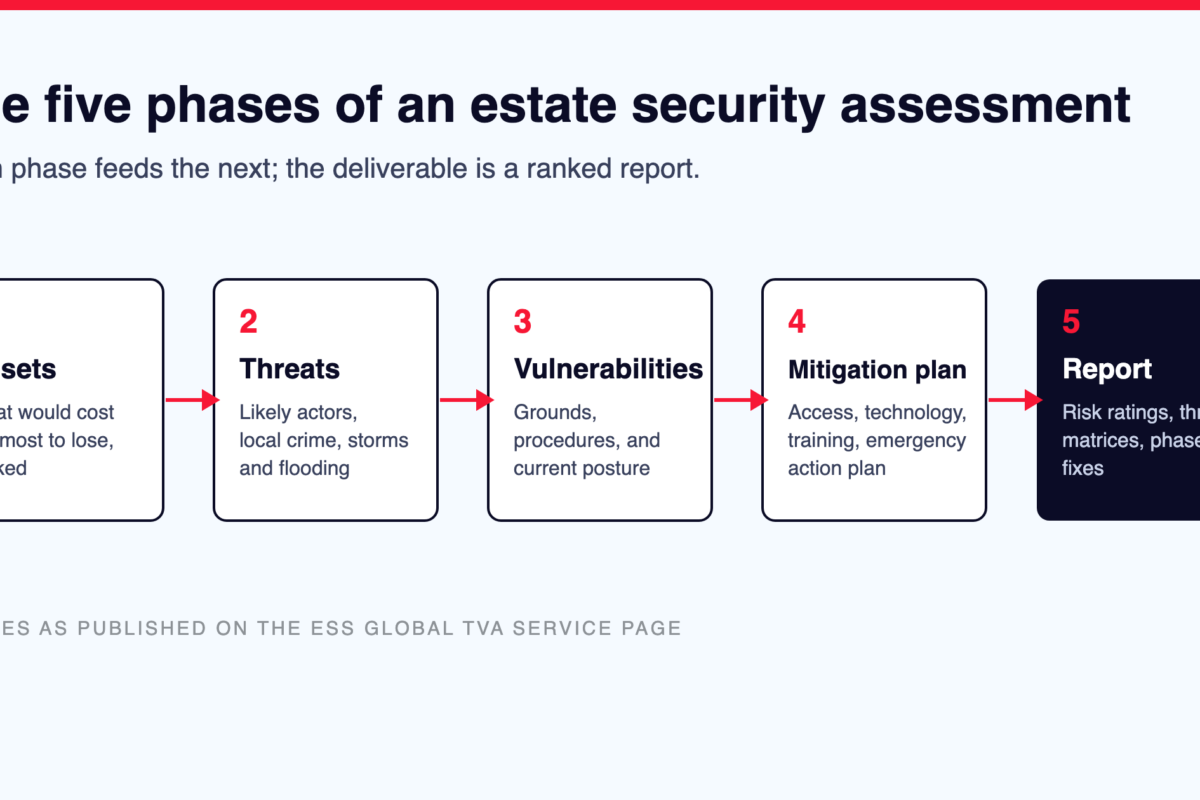
Diagram of the five phases of an estate security assessment, from asset review and threat analysis to the final report.

What an Estate Security Assessment Covers

Diagram of the five phases of an estate security assessment, from asset review and threat analysis to the final report.

An estate security assessment in Tampa Bay is a structured survey of a property, the people who live and work on it, and the threats to both. If you own or manage a large home here, the security options in front of you are sold as separate products: cameras, a monitored alarm, a gate upgrade, a patrol, an officer at the entrance. An assessment ranks your risks before you buy any of that, so you spend on the biggest problem first. ESS Global is a Tarpon Springs security agency that performs threat and vulnerability assessments across Tampa Bay alongside its guard and executive protection services. Below is what the assessor looks at in each phase and what the final report contains. There is also a license check to run on any firm before you let it walk the property.

What an estate security assessment looks at first

The first phase is an asset value assessment: a ranked list of what on the property would cost the most to lose. On an estate that list starts with people, meaning the family and everyone who works on the grounds, and it extends to the buildings and systems, and to the household’s paperwork and plans: schedules, travel arrangements, and financial documents. The assessor builds the rest of the assessment around this list.

The second phase is threat analysis: the assessor names the likely threat actors and the most dangerous things they could attempt. ESS builds that picture from open-source intelligence, law enforcement data, and what its assessors see on the ground. In Tampa Bay that includes crime rates for the surrounding area plus hurricane and flood exposure. ESS used those same sources on an assessment for a government technology facility in Florida, where the work also covered risk ratings for the people and property on site and integration planning with local law enforcement and emergency medical services.

Where the assessor looks for weaknesses

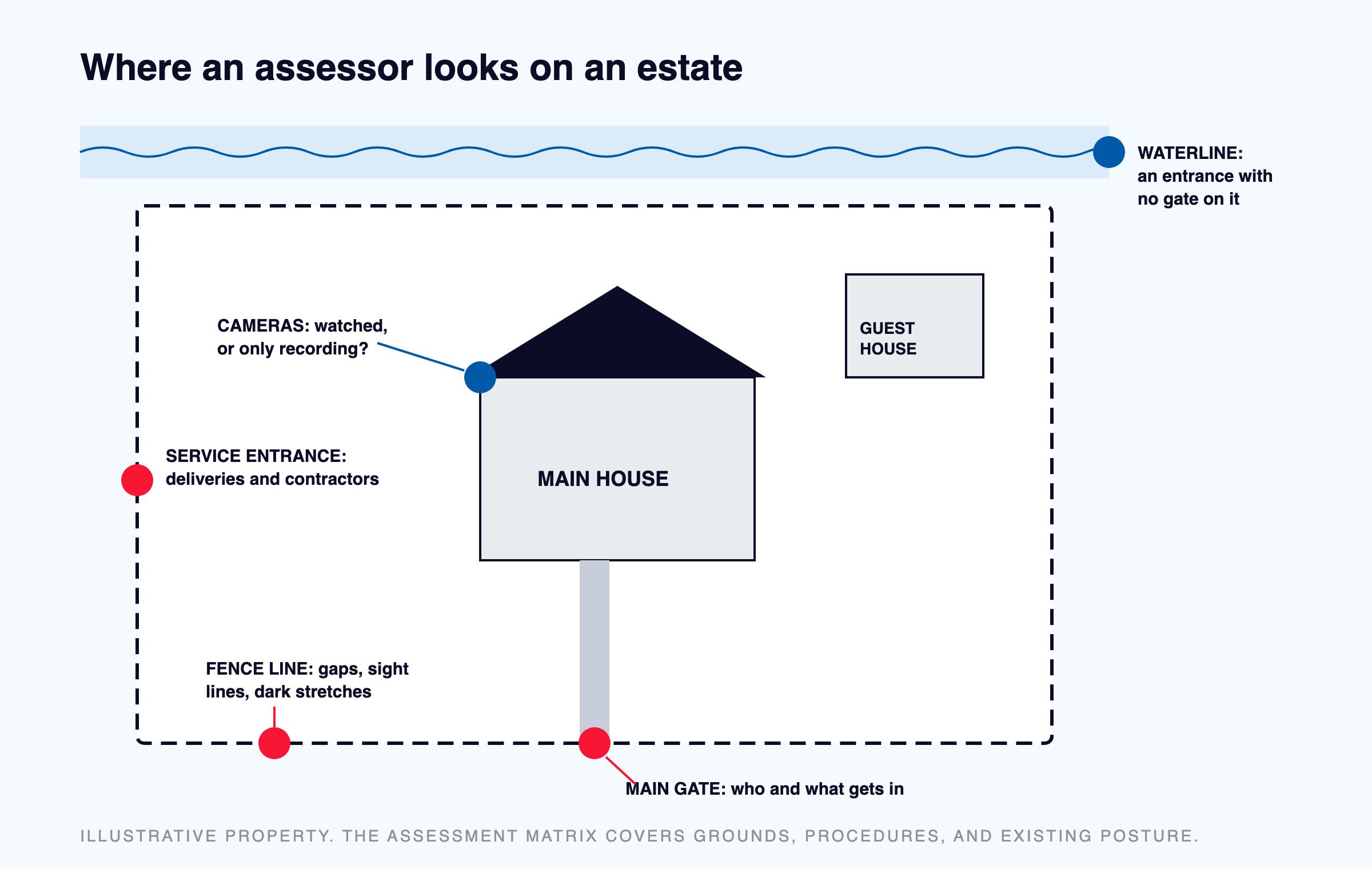
In the third phase the assessor works through a structured matrix, looking for weak points in three areas: the physical grounds, the operating procedures, and the existing security posture. On the grounds, that means the perimeter, the entrances, the sight lines, and the places where the property can be reached without being seen. Procedures cover the people on the property: who holds gate codes and keys, how deliveries and contractors get in, and what happens when a stranger rings the intercom. Posture means the security you already run: the cameras, the alarm, the lighting, and whether anyone watches the feeds or they only record.

Plan view of an estate marking the points an assessor checks: the main gate, the perimeter fence, the service entrance, camera positions, and the waterline.

The people doing this work at ESS are subject matter experts with more than 20 years of experience, and their backgrounds include U.S. State Department security service, law enforcement, and military training. The team page lists Jeffery Dick as the company’s threat and vulnerability assessment specialist. Each assessment is site-specific and shaped to the owner’s risk tolerance. ESS keeps the consultation and its findings confidential.

Inside the final report

In the fourth phase the assessor turns the findings into a mitigation plan for the property. ESS publishes what a plan can include:

  • Access control upgrades: changes to who can get onto the property, and where.
  • Technology recommendations: cameras, sensors, and communications equipment specified for the site.
  • Training protocols: basic life support, trauma care, and active shooter response for the people on the property.
  • An emergency action plan: written for the site and then practiced in drills.
  • Covert armed protection: where the threat picture calls for it, drawn from the same pool of agents as ESS’s executive protection details.

The fifth phase is the report: a board-level document containing the findings, risk ratings, threat matrices, and recommended actions. For the Florida facility above, the deliverable was a security roadmap with phased implementation and executive protection integrated into it. When the plan calls for officers on the property, ESS staffs that from its own guard services, which cover private security contracts and residential communities with armed and unarmed officers.

Making the fixes the report recommends is a separate purchase. If you already know you want a monitored alarm and nothing else, an alarm company will sell you one directly and install it well. You will still not know what else on the property needs fixing first. If you can only pay for one of the two, our position is to pay for the assessment first.

Check the license before the walkthrough

Florida licenses this industry under Chapter 493 of the Florida Statutes, and every license mentioned below is publicly searchable. A business that furnishes security services for pay must hold a Class B security agency license under s. 493.6301(1). The number is usually printed on the firm’s own site, and ESS Global’s, license B12000275, is in the footer. The individual officers need a Class D license under s. 493.6301(5), and any officer armed on your property needs a Class G firearms license on top of it under s. 493.6301(6). A Class G license requires at least 28 hours of range and classroom training under s. 493.6105. The Florida Department of Agriculture and Consumer Services runs the lookup, with one search page for agencies and schools and another for individual officers, so ask for the names of the officers assigned to your property and run them through the individual search.

The state also licenses the training: a Class D officer must complete at least 40 hours of professional training at a department-licensed school under s. 493.6303(4)(a), and the schools hold Class DS licenses under s. 493.6301(7). ESS runs one of those schools, ESS Academy in Tarpon Springs, under school license DS1400022, and the Academy lists more than 2,240 graduates. Its courses include the state’s 28-hour Class G firearms training and the trauma care training that mitigation plans recommend, and ESS trains its own officers there before assigning them to client properties.

Getting one scheduled

The first step is a consultation: call 727-940-7926 or write to info@essglobalcorp.com. Have three things ready: the property address, a list of the security you already have, and whatever prompted the call. For properties inside an association, ESS management also attends board and committee meetings. The quote is free, and the full description of the assessment service is on the threat and vulnerability assessment page.

Request a free quote

Safeguarding Private School Campuses and Student Events


At ESS Global, we consider it a profound honor to protect our communities’ most valuable treasures—our children.

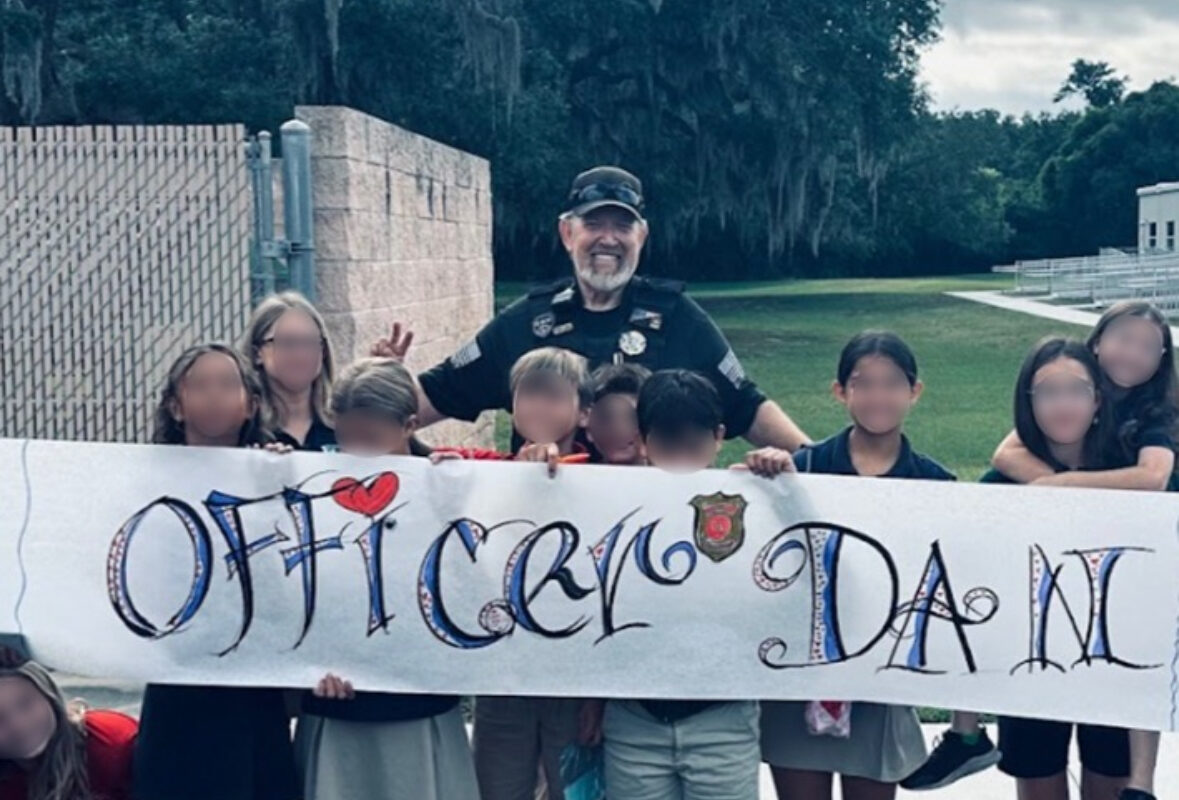
Pictured here are members of our dedicated security team actively safeguarding private school campuses and student events. These aren’t just assignments; they’re missions. From morning drop-off to after-school events, our guards provide a steady, reassuring presence—ensuring peace of mind for parents, faculty, and students alike.

We don’t take lightly the responsibility of protecting learning environments. Every post we stand, every door we monitor, and every interaction we have reflects our deep commitment to safety, discretion, and care.

Because when children feel safe, they can truly thrive.
And that’s what drives us every single day.

#ESSGlobal #SchoolSecurity #CampusSafety #ProtectingOurFuture #PrivateSchoolSecurity #SecurityThatCares #SafeSchools #CommunityGuardians #SecurityWithPurpose

Precision in Motion. Protection in Every Mile.

Global Protection. Local Precision.
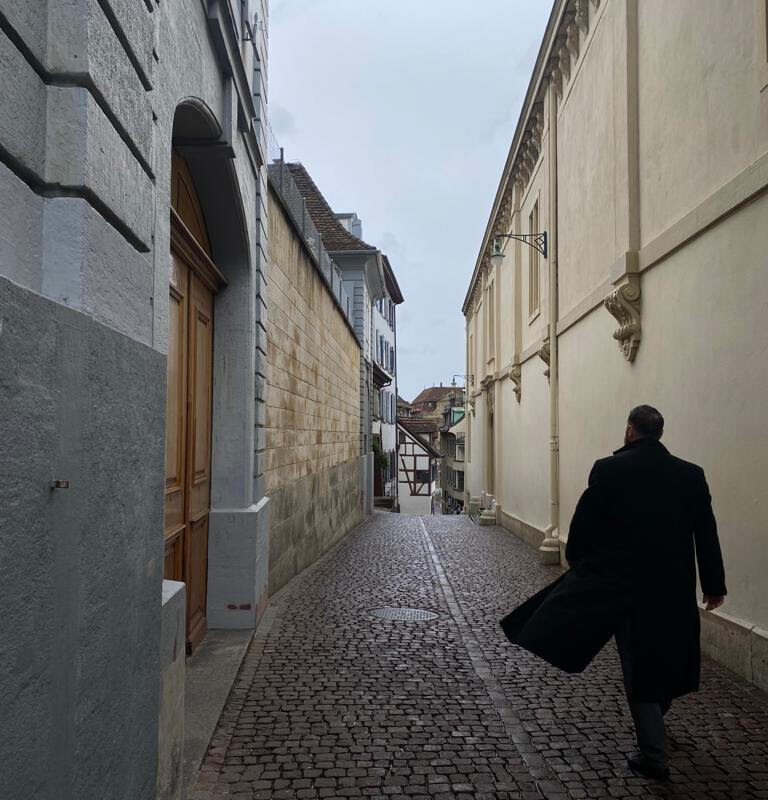
Pictured here is one of our Executive Protection Agents on assignment in Germany, executing a critical international detail.

At ESS Global Corporation, our EP agents are trained to operate across borders with the highest level of discretion, cultural awareness, and operational discipline.

When working abroad, an EP agent must:

 Conduct detailed advance work, accounting for local laws, customs, and threat levels
–  Navigate unfamiliar environments with precision and adaptability
–  Liaise with foreign security teams, embassies, and local law enforcement
–  Protect the client’s safety, reputation, and privacy—at all times

Our agents don’t just travel with the client—they become the first line of defense, no matter the country or the complexity of the mission.

Whether it’s Berlin, Dubai, or São Paulo—ESS Global protects what matters most.

#ExecutiveProtection #ESSGlobal #InternationalSecurity #CloseProtection #GlobalSecurity #SecurityWithoutBorders #TravelSecurity #ProtectionProfessionals #ClientSafety #EPAgentAbroad

Why continue to train?

Why continue to train ?

ESS GLOBAL CORP. has a core value of Excellence.  It means, “the quality of being outstanding or extremely good.”  We continue to get better when we forge ourselves in the fires of training.  Whether physical or mental training, the body must be re-calibrated to perform at its best.

“What you aim at determines what you see.”

Peterson-


Do you Need to train ?

ESS ACADEMY SEPTEMBER’S COURSE FOR COMBAT PISTOL  & THRID PARTY SHOOTING HAS BEGUN!

This week kicks off September’s combat pistol and Third Party Shooting.  This class has received rave reviews from so many of our students. One of our personal favorites :

Colonel Myron Fonsake,  “I learned more in this three days of shooting than in a career in Law enforcement and Military Services.”

This course will challenge any shooter and any skill level. We focus on the basics and drill the fundamentals until they become muscle memory.  This course gets proven results.  We give a test at the beginning of the course and  re-test at the end of the course and 92% of people have dramatic improvement.

Look forward to training with you soon!

  ESS ACADEMY COURSES