

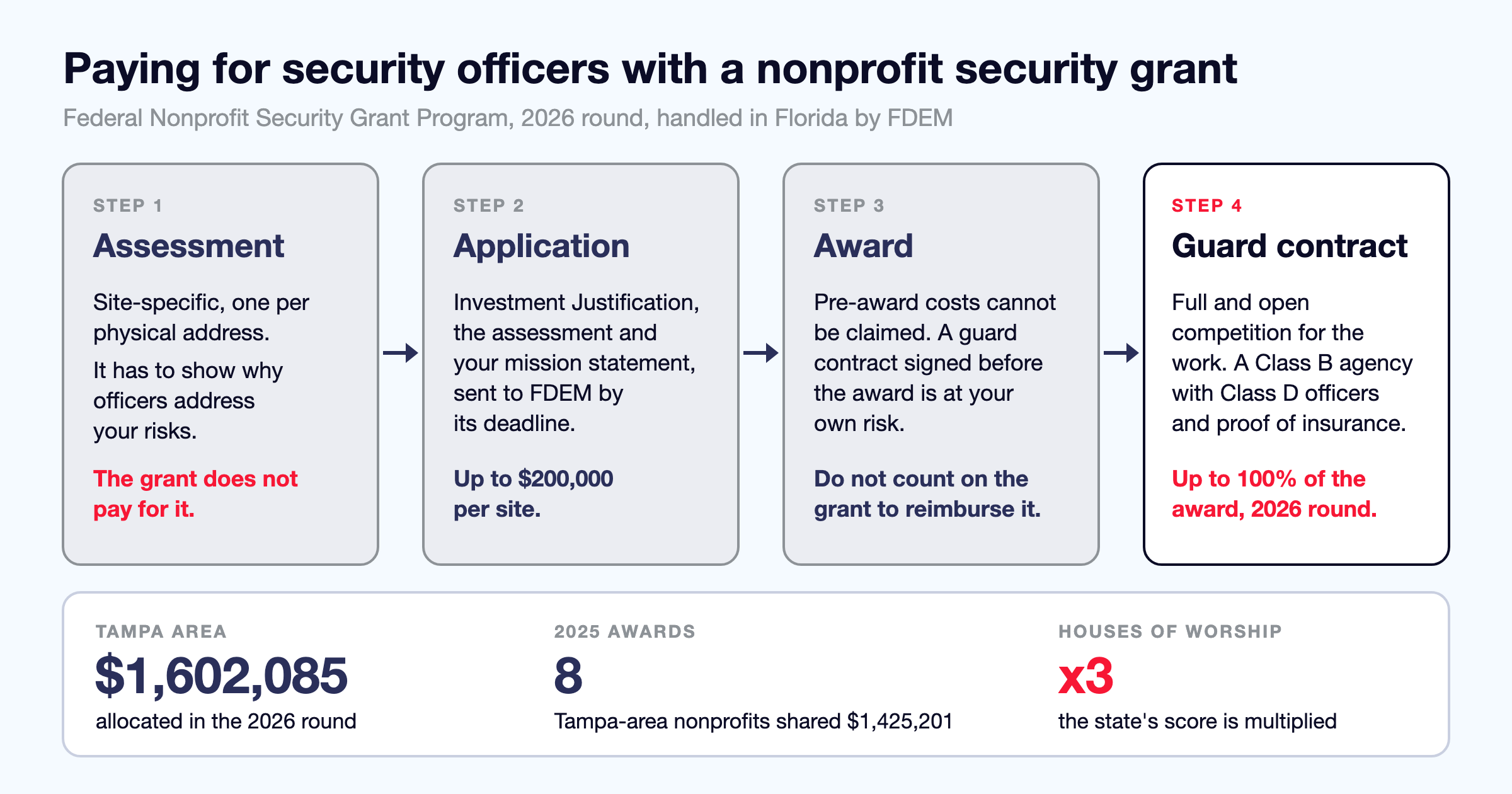
If your church, synagogue or private school wants a security officer on campus but lacks the budget, a nonprofit security grant may cover the cost. The federal Nonprofit Security Grant Program (NSGP) is run by FEMA, and the Florida Division of Emergency Management (FDEM) handles it in Florida. The program lists "private contracted security guards" as an example project. In the 2026 round, a nonprofit could spend 100% of its award on contracted security personnel.
The rules change each year. As of November 2026, FEMA has not published the notice for the 2027 round, so the latest federal rules are those of the 2026 round. Check the next notice before you apply.
Who can apply for a nonprofit security grant
In the 2026 round, applicants had to be 501(c)(3) organizations. Churches, mosques and synagogues "are not required to provide recognition of exemption." Each applicant also had to show, through its application, that it is at high risk of a terrorist or other extremist attack. FEMA names houses of worship and educational facilities among the eligible types.
One funding stream serves nonprofits inside a designated high-risk urban area, and another serves nonprofits outside one. The "Tampa Area" is one of Florida's four funded urban areas, along with Jacksonville, Miami/Fort Lauderdale and Orlando, and it was allocated $1,602,085 in 2026. The local urban area working group decides which addresses fall inside the Tampa Area, so ask FDEM which stream your site belongs in.
A nonprofit could request up to $200,000 per site, for up to three sites per funding stream. The scoring favors houses of worship and religious schools. For either one, the score the state's reviewers give the application is multiplied by three, and applicants that have never received an NSGP award get 15 points added. Expect competition all the same: eight Tampa-area nonprofits shared $1,425,201 in 2025.
Florida also has a state program under section 252.3712, Florida Statutes. It allows grant money to be used for "hiring security personnel," with awards ranging from $10,000 to $150,000. As of November 2026, the state is not taking applications. You can email FLNSGP@em.myflorida.com to be notified if funding opens. In the 2024 state round, security personnel costs were capped at 50% of the award.
The vulnerability assessment comes first
Under the 2026 federal rules, the application has three parts: the Investment Justification (IJ), which describes your project and budget; a vulnerability/risk assessment; and your mission statement. All three go to FDEM by its deadline. The assessment must be "site-specific" and "unique to the site," and "one vulnerability assessment is required per physical address."
The grant does not pay for the assessment. "Initiatives that fund risk or vulnerability security assessments or the development of the Investment Justification" are not allowable costs, so the nonprofit pays for the assessment itself.
The assessment also has to support the request. Reviewers score the alignment between the projects you request and the vulnerabilities your assessment identifies. If you are asking for officers, the assessment should show why officers address your risks.
Florida's assessment worksheet from the 2024 state program shows what reviewers look for. It asks about threats, vulnerabilities and mitigation options, consequences, perimeter, lighting and physical protection, along with incidents from the last five years. It also asks for the name, credentials and signature of each assessor, an aerial photo of the site, and your local law enforcement agency and fire department. The latest Florida guide for the federal program recommends working with your local police department on the assessment. It also points applicants to a self-assessment tool designed for someone with little or no security experience. The tool comes from CISA, the federal Cybersecurity and Infrastructure Security Agency.
Our threat and vulnerability assessment is a site-specific review that shows where your current setup would fail against the threats your site is likely to face. We work through five steps: asset value, threat analysis, vulnerability identification, a mitigation plan and an executive report with risk ratings, findings and a phased roadmap. We assess churches, faith-based campuses and schools, and the report is yours to use with any provider. FDEM decides which assessments it accepts, so ask FDEM what it requires before you commission one from anyone, including us.
What the grant requires of the guard contract
Rules on what the grant will pay for. In the 2026 round, contracted security had to follow FEMA's Information Bulletin 441. Grant funds "may not be used to purchase equipment for contracted security," and overtime and backfill are not allowable. Off-duty law enforcement officers can be paid only when they work as contract security.
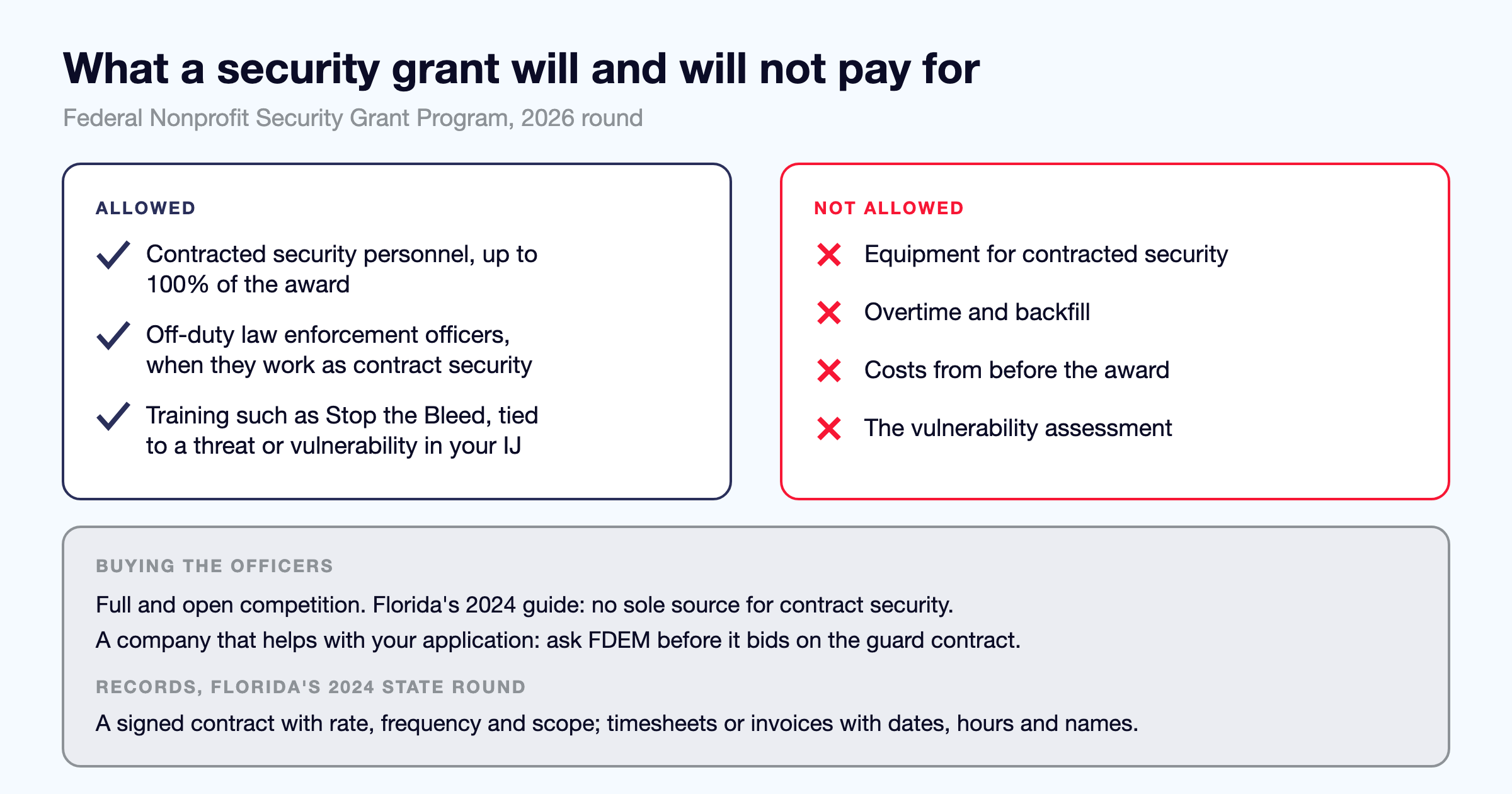
Budget detail. In its 2024 guide, Florida required the IJ to show the hourly or daily rate, the number of officers and the expected hours or days over the grant period. It also required a sustainment plan at closeout showing how you will keep the coverage going without the grant.
Timing. "Subrecipients cannot claim pre-award costs," and starting work before the award is at your own risk. If you sign a guard contract before the award, do not count on the grant to cover what you pay under it before then.
Competitive bidding. "All procurement transactions under a federal award must provide for full and open competition." For smaller purchases, federal rules require price quotes from "an adequate number of qualified sources." Florida's 2024 guide did not allow sole-source procurement for contract security personnel. Under the 2024 state program, a nonprofit that contracted with and paid a sheriff's office directly did not need other bids, but one that paid an off-duty officer directly or hired a private company did.
Conflicts of interest. The 2026 notice bars contractors that draft specifications or requests for proposals from competing for that work. FEMA "extends this restriction to contractors who assist recipients or subrecipients in developing grant applications, project plans, or budgets." If a company helps with your application, ask FDEM before that company bids on your guard contract.
Records. In the 2024 state round, FDEM required a signed contract that breaks down "the rate, frequency, and scope of services," along with timesheets or invoices showing the dates, the hours worked and each officer's name.
What to ask of the security company
The grant documents do not set a licensing standard for guard companies, but Florida law does. A company in the security business must hold a Class "B" agency license, and every officer must hold a Class "D" license. Armed officers also need a Class "G" firearms license. Florida issues a Class B license only after the agency files a certificate of general liability insurance of at least $300,000 with the state. Ask every bidder for its license number and a certificate of insurance.
ESS Global Corp is a Florida-licensed security agency (license B 1200075), fully insured, and has protected clients since 2011. Our officers are individually licensed by the State of Florida, and each one completes our in-house training at ESS Academy before working a post. We staff armed and unarmed officers at schools and places of worship throughout Tampa Bay. Our officers keep logs of incidents, patrols and observations.
The grant can also pay for training, including "Stop the Bleed" and emergency first aid courses for staff, volunteers and congregants, as long as the training addresses a threat or vulnerability identified in your IJ. ESS Academy offers a one-day Trauma & Advanced Bleeding Control course for church safety teams and event staff. Confirm with FDEM that a course qualifies before you budget for it. For the broader planning work, see our church security plan for Florida congregations.
Start with a conversation
Whether you are preparing your first application or pricing officers for a grant budget, we can assess your site or quote licensed officers for it. A threat and vulnerability assessment begins with a short scoping call at no cost, and most of our security officer quotes go out within one business day. Call 727-940-7926 or request a quote for a threat and vulnerability assessment or for security officers.