
An HOA board in Florida that wants security guards has to know, before it signs, whether Florida law makes it take competing bids and which rules the officers can enforce on the property. HOA security guards are licensed officers from a Florida security agency, hired by an association to watch its gate and common areas and enforce its rules. ESS Global is a licensed Florida security agency in Tarpon Springs that has protected clients since 2011, and it provides HOA security officers to communities in Tampa, Clearwater and St. Petersburg. This guide covers how to choose the posts, which licenses and insurance to check, what Florida requires of the contract and the bids, what officers can and cannot enforce, and how to get a proposal from ESS.
What HOA security guards do in a community
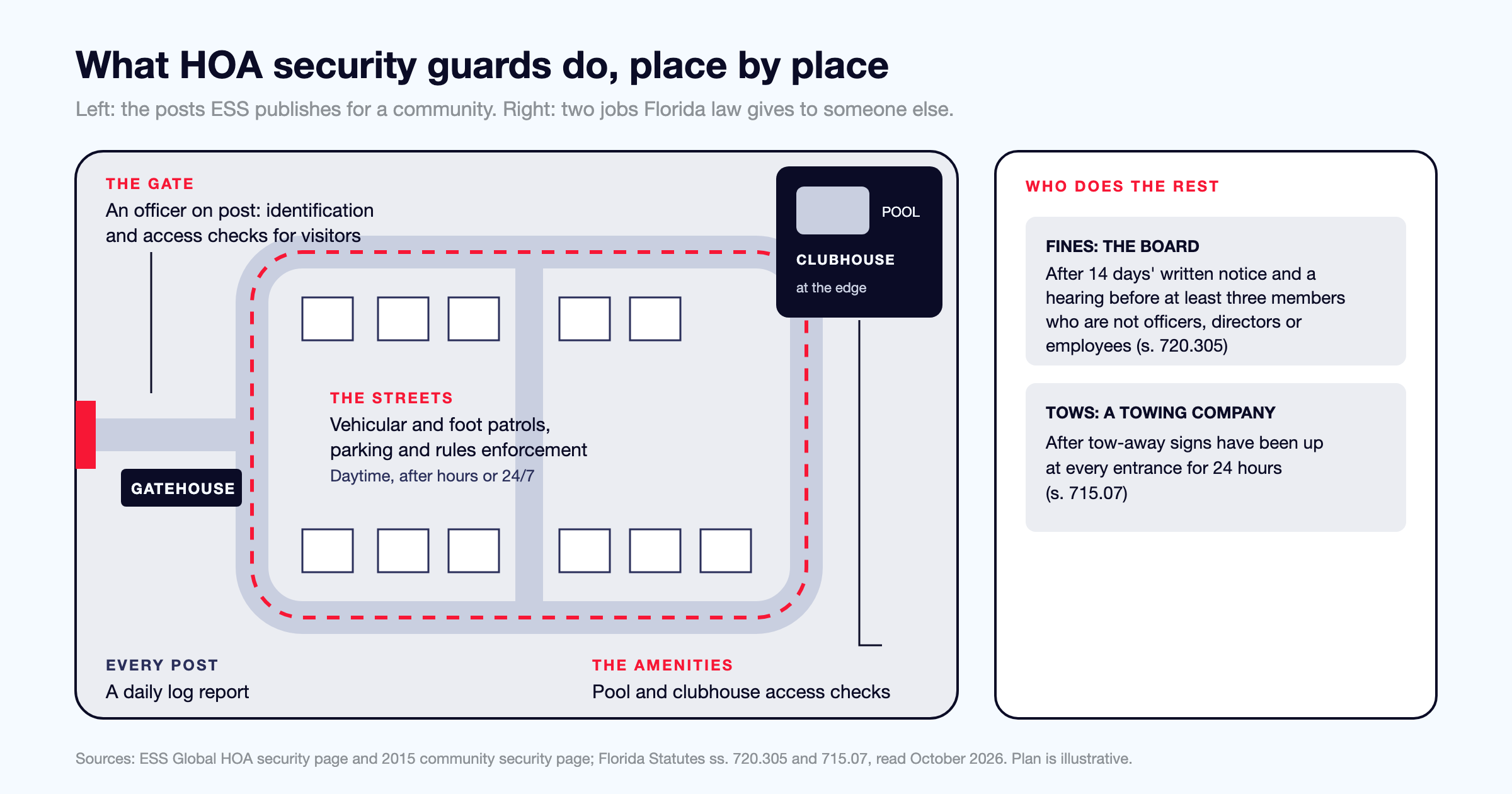
ESS's 2015 page on apartment, condominium and HOA security lists the services ESS provides to a community, among them gate guards, walking guards and mobile patrols, pool and clubhouse access, identification checks, alarm monitoring and response, parking enforcement and policy enforcement, with complete daily log reports. The same page says ESS officers are present for evictions and for conflict resolution. ESS's current HOA security page offers armed and unarmed officers. It also notes that pools, gyms, spas, parks and playgrounds are often on the edges of a property, where they are harder to supervise. The Crescent Oaks testimonial on ESS's site calls ESS's gate guards courteous and friendly and recommends them "to any HOA looking to improve their community's security services."
Before asking for a proposal, list each place you want an officer and the hours for each one: the gate, the streets at night, the pool and clubhouse while they are open, and the parking lots. ESS's security guard services page offers daytime coverage, after-hours monitoring or full 24/7 protection, and the FAQ says ESS can staff a site with anything from a single officer to a full detail. ESS offers associations a free security analysis. The FAQ says ESS will recommend armed or unarmed officers for each site.
The licenses and insurance to check
Check two kinds of license: the company's Class B agency license, and a Class D for every guard it puts on your property. A Class D takes at least 40 hours of training at a school licensed by the Florida Department of Agriculture and Consumer Services (FDACS). An officer who carries a firearm also needs a Class G, which takes 28 hours of range and classroom training. On duty, the officer must have the license in his or her possession and, except on a limited special assignment, wear a uniform with at least one patch or emblem that identifies the agency. Ask each bidder for its agency license number and the names of the officers it plans to assign, and look up both on FDACS's licensee search, which has one form for individuals and another for agencies and schools.
FDACS will not issue a Class B license until the agency files proof of commercial general liability insurance of at least $300,000 combined single limit, with the department named as an additional insured so that it receives any notice of cancellation. If the policy is cancelled, the agency's license is suspended automatically on the cancellation date unless the agency shows the department new coverage first, so ask each bidder for its certificate of insurance and check that it is current on the day the contract starts. Under that rule, an agency whose Class B license has not been suspended has that coverage on file with FDACS, and ESS's agency license is B 1200075. ESS's FAQ says the company is fully insured and that "our officers are individually licensed by the State of Florida and screened, trained, and supervised by our leadership team." ESS's owner, Theodore Billiris, holds the Class B agency license and his own Class D, both since 2011. ESS trains its officers in-house at ESS Academy, the company's Class DS school (license DS1400022), which teaches the Class D course as 42 hours of instruction in Tarpon Springs or live online, along with the Class G course its armed officers need, and the FAQ says officers finish that training "before stepping on post."
The contract and Florida's bid rule
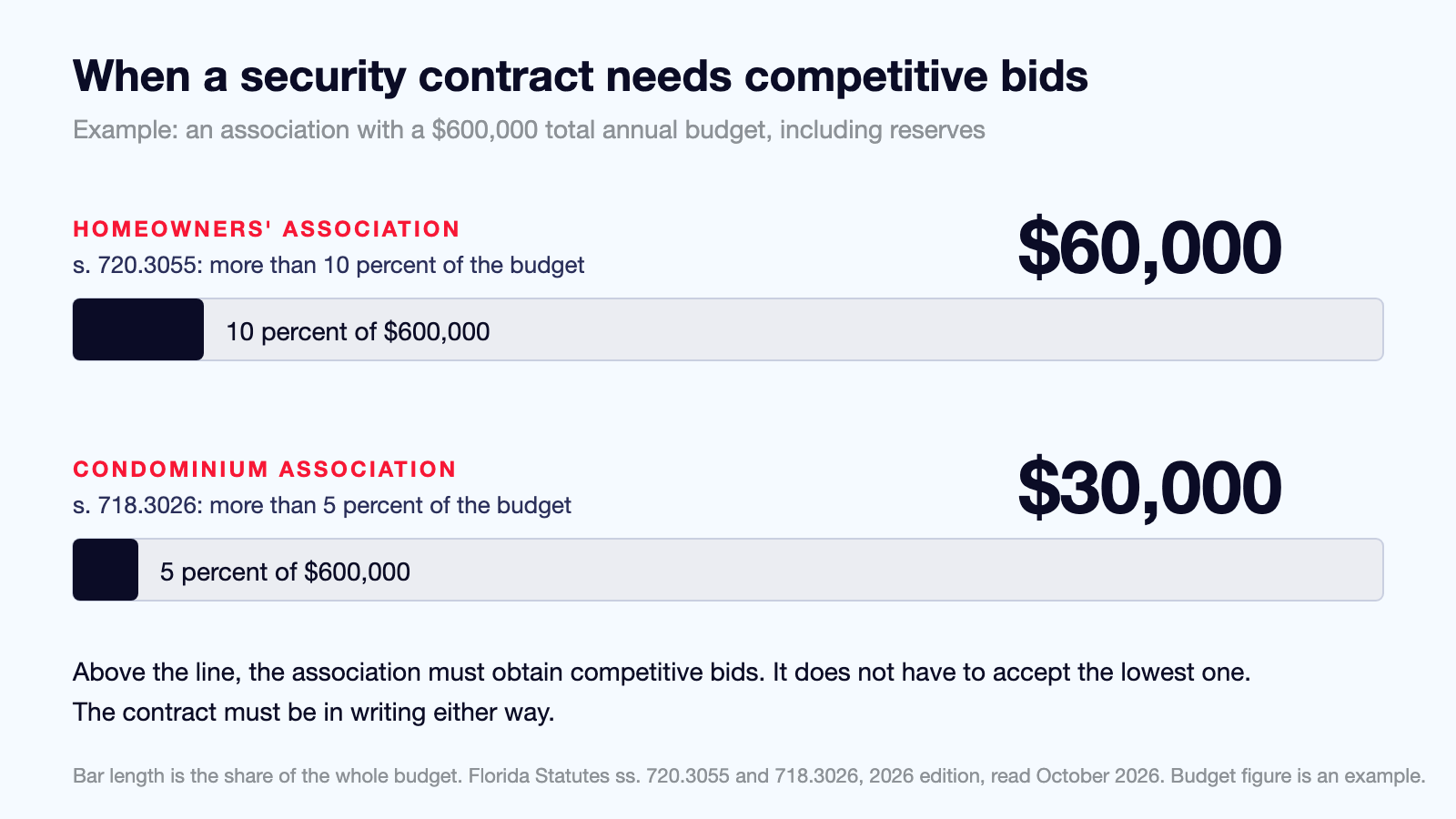
Section 720.3055 requires every contract an HOA signs for services to be in writing. If a security contract requires payment by the association of more than 10 percent of its total annual budget, including reserves, the association must obtain competitive bids, under its own declaration or bylaws if they set a procedure at least as strict. For example, an association whose annual budget is $600,000 including reserves must take bids on a security contract that requires payment of more than $60,000. In an emergency, the association can hire security without taking bids, and ESS's 2015 page says it supplies uniformed officers for emergency and short-term work as well as long-term posts. Condominium associations, which ESS's 2015 page also covers, follow section 718.3026 instead and take bids above 5 percent of the total annual budget including reserves.
Ask every bidder for a separate price on each post; the board does not have to accept the lowest bid. ESS's FAQ says it assesses the location and the hours of coverage before it writes a proposal, and that most written proposals go out within one business day. That proposal, like every bid the association receives, is an official record the association has to keep for one year, and the signed contract is an official record too. A contract awarded through competitive bids can be renewed without new bids if it lets the board cancel on 30 days' notice.
What the officers can and cannot enforce
Under section 810.09, a person who defies an order to leave the grounds, given in person by the owner or by an "authorized person", commits a first-degree misdemeanor. Section 810.08 covers a building such as a clubhouse, where entering or staying without permission is trespass, and so is refusing to leave after a warning from the owner or a person the owner authorizes. Section 810.09 defines an authorized person as the owner, the owner's agent, or a community association authorized as an agent for the owner. ESS's officers can check access and enforce the association's rules on the common areas, but under section 810.09 the order to leave has to come from the owner or an authorized person. If the board wants ESS's officers to give that order, write that authority into the contract.
Under section 720.305 the board can fine an owner up to $100 per violation, and up to $1,000 in total for a continuing violation, unless the governing documents set other limits. No fine or suspension can be imposed until the board gives the owner at least 14 days' written notice of a hearing before a committee of at least three members who are not officers, directors or employees of the association, and the notice must describe the alleged violation. The committee has to hold the hearing within 90 days of the notice, and the fine goes ahead only if a majority of the committee approves it. Ask that the officers' daily logs go to the manager or the board. If the board suspends an owner's use of the common areas, the owner or tenant can still drive or walk through the gate to the parcel and park there.
ESS's officers can enforce parking rules, but only the owner or a person the owner authorizes can have a car towed, and under section 715.07 that person is not liable for the cost of removing or storing a vehicle parked without permission. Unless the driver is told in person, a tow-away sign with the wording and letter sizes the section specifies, and the towing company's name and phone number, has to stand at each driveway entrance for at least 24 hours before any tow. Cities and counties can add their own towing rules to the state's, and a person who has a vehicle towed improperly is liable to its owner for the towing and storage costs, any damages, and attorney's fees and court costs. Check that the signs are up before the board authorizes anyone to call a tow.
Getting a proposal for your community
Call ESS on 727-940-7926 from 9 to 6, Monday to Friday, or send the quote form at any hour. On that call, ask ESS to schedule the security analysis, and have these ready: the annual budget including reserves, the association's rules and parking policy, and the hours you want the gate staffed and the amenities covered. ESS management will also come to a board or committee meeting. ESS's office is at 425 E. Spruce St., Suite A, in Tarpon Springs.