
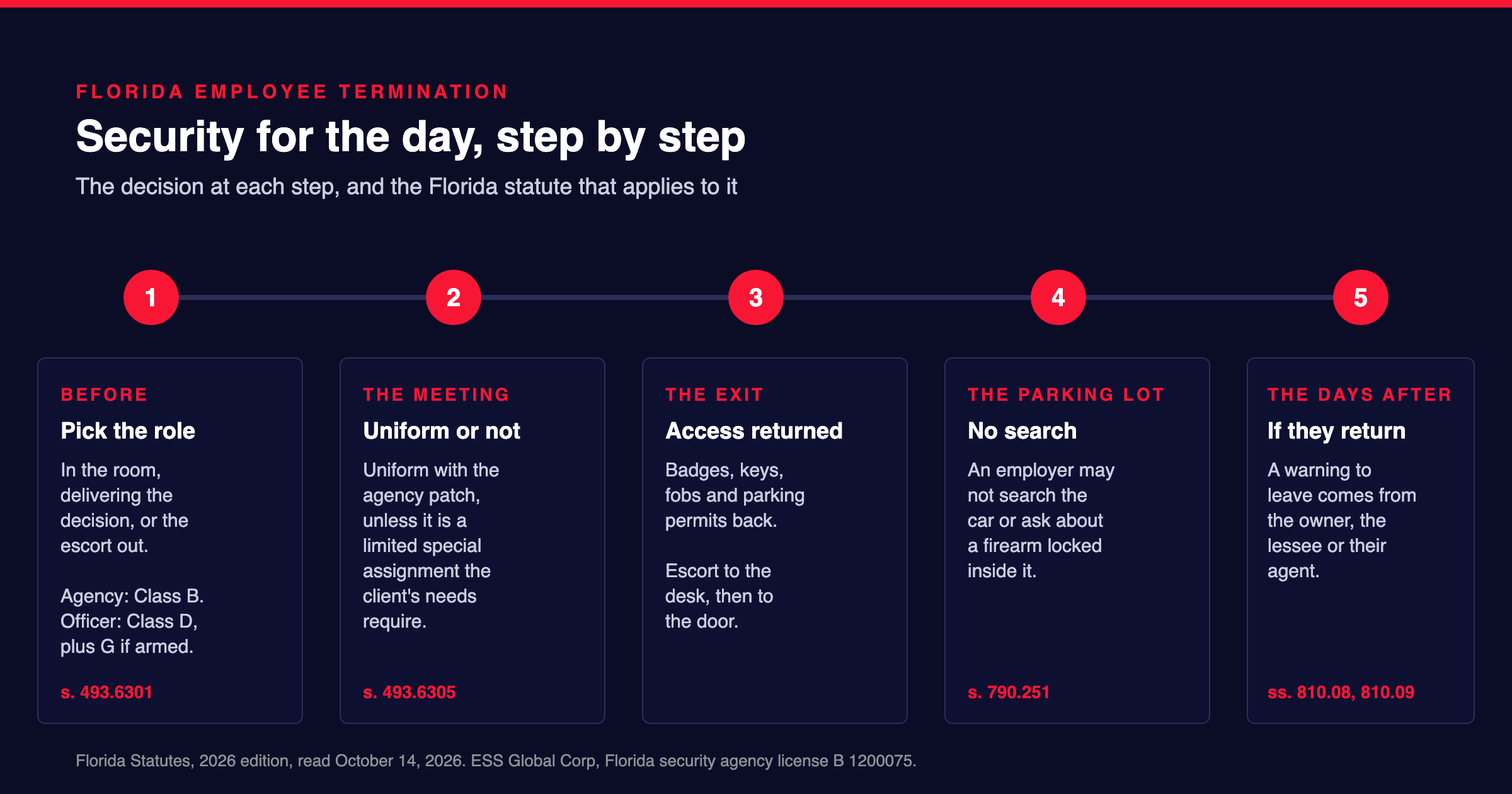
If you have decided to let an employee go and the way they have behaved makes you unsure how they will take the news, decide who will be in the room and how the person will leave before you set a date for the meeting. Kathleen Bonczyk, founder of the nonprofit Workplace Violence Prevention Institute, told CNN in 2019 that "the point of termination is perhaps the greatest opportunity for deadly workplace violence." Employee termination security means a licensed officer at a termination: in the room, delivering the decision for you, or escorting the person out. ESS Global is a Florida security agency in Tarpon Springs, licensed as agency B 1200075, and we provide officers for terminations across Tampa Bay. This guide covers how to know whether a termination needs an officer, which role to book, what Florida law says about the exit and the parking lot, and what to set up for the days after.
Deciding on employee termination security
OSHA has no workplace violence standard, and no specific rule requires a threat assessment as part of a termination plan. OSHA's general duty clause still requires employers to keep the workplace free of hazards likely to cause death or serious harm. If you are concerned about threats to your whole building or site, our threat and vulnerability assessment works out who is likely to pose a threat and where your building and your procedures are weak, and ends in a written report with recommended actions. If you only suspect the employee, for example of stealing inventory or of filing a workers' comp claim their social media contradicts, ESS can have licensed investigative partners look into it first. Our guide to when Florida businesses need a private investigator explains how a workplace investigation runs and what is in the written report at the end.
Jeff Sweetin, a corporate security consultant who spoke at SHRM's 2018 annual conference, named abusive language and violent gestures among the obvious warning signs, and said managers and co-workers sometimes ignore odd behavior because they are used to it. Bonczyk told CNN that the most dangerous firings can be of employees who have been there a long time. Steve Albrecht, a threat assessment expert and co-author of "Ticking Bombs: Defusing Violence in the Workplace," told CNN that companies should not assume an employee would never turn violent just because they have no criminal record. Marc McElhaney, a psychologist whose firm helps companies separate high-risk workers safely, advises getting the managers who know the employee together and comparing what each of them has seen, because in one of his cases no one person in the company knew everything the employee was dealing with. Write those observations down and bring the list when you book an officer.
Take the same precautions with every termination: have a second manager and security in the room. If you think the person may react violently and your building has no security staff of its own, hire an officer for the termination. Sweetin says to meet with your lawyer and your security staff together once you have assessed the threat. Once you have decided, he says to do it quickly, and Albrecht says not to warn the employee that it is coming.
Choose the officer's role
| Role we staff | What our officer does | What it is for |
|---|---|---|
| In the room | Sits in on the termination meeting and watches for signs of escalating behavior | An officer the employee can see, which often deters confrontation |
| Facilitated termination | Represents you in the room, tells the employee the termination decision and manages the process | Terminations where you already expect hostility, or where executives want more protection and discretion |
| Escort and exit | Walks the former employee off the premises, to their vehicle or to another place you name | Protecting company property and keeping work going while the person leaves |
Albrecht told CNN that the sight of a uniformed guard "raises the emotional temperature of the employee being terminated," and that it is better to have an armed guard nearby, outside the door or listening in, with a code word for when to come in, or to have security in plain clothes in the room. Sweetin told the SHRM conference to have security officers present but keep them low-profile. Section 493.6305 of the Florida Statutes requires a Class D security officer to work in a uniform with the agency's patch visible at all times. It allows plain clothes only on a limited special assignment, when the duty or the client's special requirements make it necessary. An officer who also holds a Class G firearms license may carry a concealed firearm on that kind of assignment. If you want plain clothes, tell us when you book and give the reason.
Under section 493.6301, a security agency needs a Class B license, and ours is printed in the footer of this site. Every officer needs a Class D license, plus a Class G license if they carry a firearm. The Florida Department of Agriculture and Consumer Services runs a public licensee search, so ask any agency for the names of the officers it will send and look them up. We train our own officers at ESS Academy, which holds Florida Class DS security officer school license DS1400022.
Plan the room, the exit and the parking lot
Sweetin says to keep the meeting short and not argue, and to limit the employee's contact with the supervisor and co-workers once the decision is made. If the meeting may turn volatile, hold it in a room near an exit and ask the people who sit nearby to take an early lunch. Sweetin warned against asking a large employee to act as an unofficial "bouncer" instead of using security officers, because that employee is not trained and the company is liable if either of them is hurt in a fight. Before the meeting, list every badge, key, fob and parking permit the person has, and collect them in the room.
If the person needs to collect belongings, have a supervisor and security walk with them to the desk. FindLaw says an employee leaving on good terms can collect their own things, and otherwise warns against "a spectacle of having security march them to their desk with a box." Then walk the person to the door and watch them leave the premises. Officers we send for a termination stay nearby for a short time after the person has gone. Sweetin says to check how the person usually gets home, and to arrange a cab if they carpool.
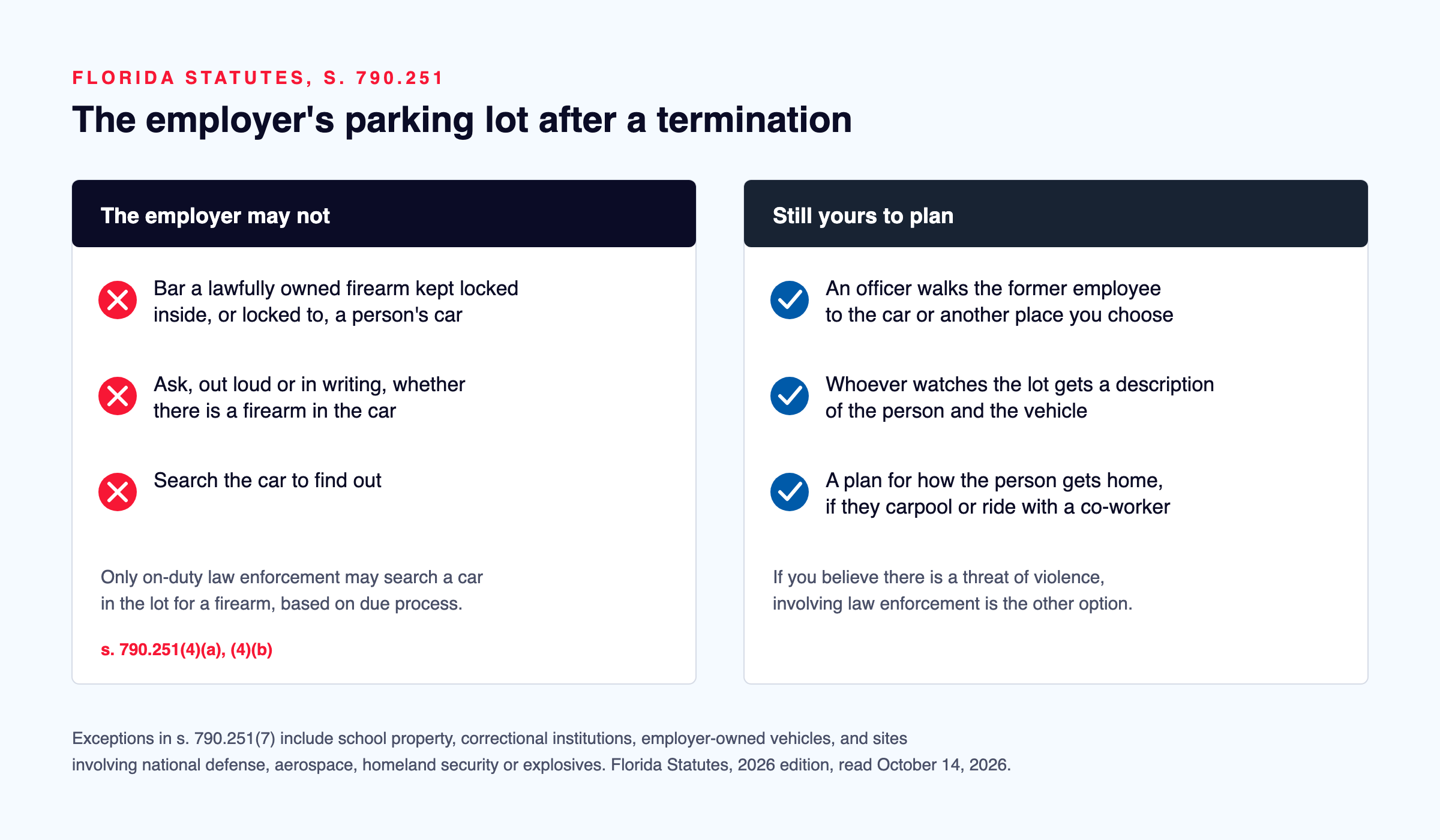
Section 790.251 of the Florida Statutes bars employers from prohibiting any customer, employee or invitee lawfully in the parking lot from keeping a legally owned firearm locked inside, or locked to, their private vehicle. The same section bars employers from asking, out loud or in writing, whether there is a firearm in the vehicle, and from searching the vehicle for one. The statute allows a search of a car in the lot only by on-duty law enforcement acting with due process. The rule has exceptions, including school property, correctional institutions, vehicles the employer owns, and sites involving national defense, aerospace, homeland security or explosives. If one of our officers walks the person to their vehicle or watches the lot, give the officer a description of the person and the vehicle.
What a security officer cannot do
Albrecht told CNN that violence after a firing can come within two weeks, while the person is still angry and has time to plan, or around two years later if they have not found a job. If the employee threatened anyone during the meeting, Sweetin says to hire officers to protect your staff afterwards, and we can station armed guards or a dedicated on-site team at your building for those weeks, around the clock if you need it. For the same weeks Albrecht says to "listen for the leakage," because people who plot attacks often confide in someone, and to make sure the person's friends at the company feel comfortable reporting threats. McElhaney's warning is that once an employee is fired, "companies don't have a lot of options to deal with him or his behaviors."
Albrecht also told CNN to keep the person on the employee assistance program for a while after the firing. He recommends what he calls a "benevolent severance," such as severance pay or a temporary extension of benefits. In his words, "There's just less animosity, less desire for revenge when you treat people like adults." Settle the severance and benefits before the meeting, and have whoever delivers the decision tell the person in the room.
The days after the termination
If the person comes back, section 810.08 of the Florida Statutes makes it trespass when a person who was once allowed into a building is warned to leave by the owner, the lessee or someone they authorize, and refuses. For open property such as a parking lot, section 810.09 lets you give the warning by telling the person directly. McElhaney cautioned against automatically barring a fired employee from the premises or seeking a restraining order, because it might make the person angrier. Decide case by case, and write down who will give a warning to leave on the company's behalf.
Tell the rest of the staff that the person no longer works for the company, without going into the reasons, and remind them not to share company information with the former employee. Give the receptionist a photo of the person and tell them who to call if the person shows up. FindLaw says to be polite and to call security, or the police if you have no security. If you have booked our guards for the weeks after, they are the security to call.
To book an officer for a termination, call 727-940-7926 (Monday to Friday, 9:00 to 6:00) or email info@essglobalcorp.com. Have the date and time ready, along with the address, the room you plan to use and its nearest exit, how the person gets to and from work, and what has made you concerned. Our corporate termination page describes the service, and the security guard services page covers guards for the weeks after.