
title: "Construction Site Security in Tampa Bay: A GC's Guide"
meta_description: "Most job site losses happen after the last crew leaves. Here is what construction site security covers in Tampa Bay, from gate logs to overnight patrols."
target_query: "construction site security tampa"
intent: "commercial, local"
status: "draft"
client: "ESS Global Corp"
reviewer: "Jake"
Construction Site Security in Tampa Bay: A GC's Guide
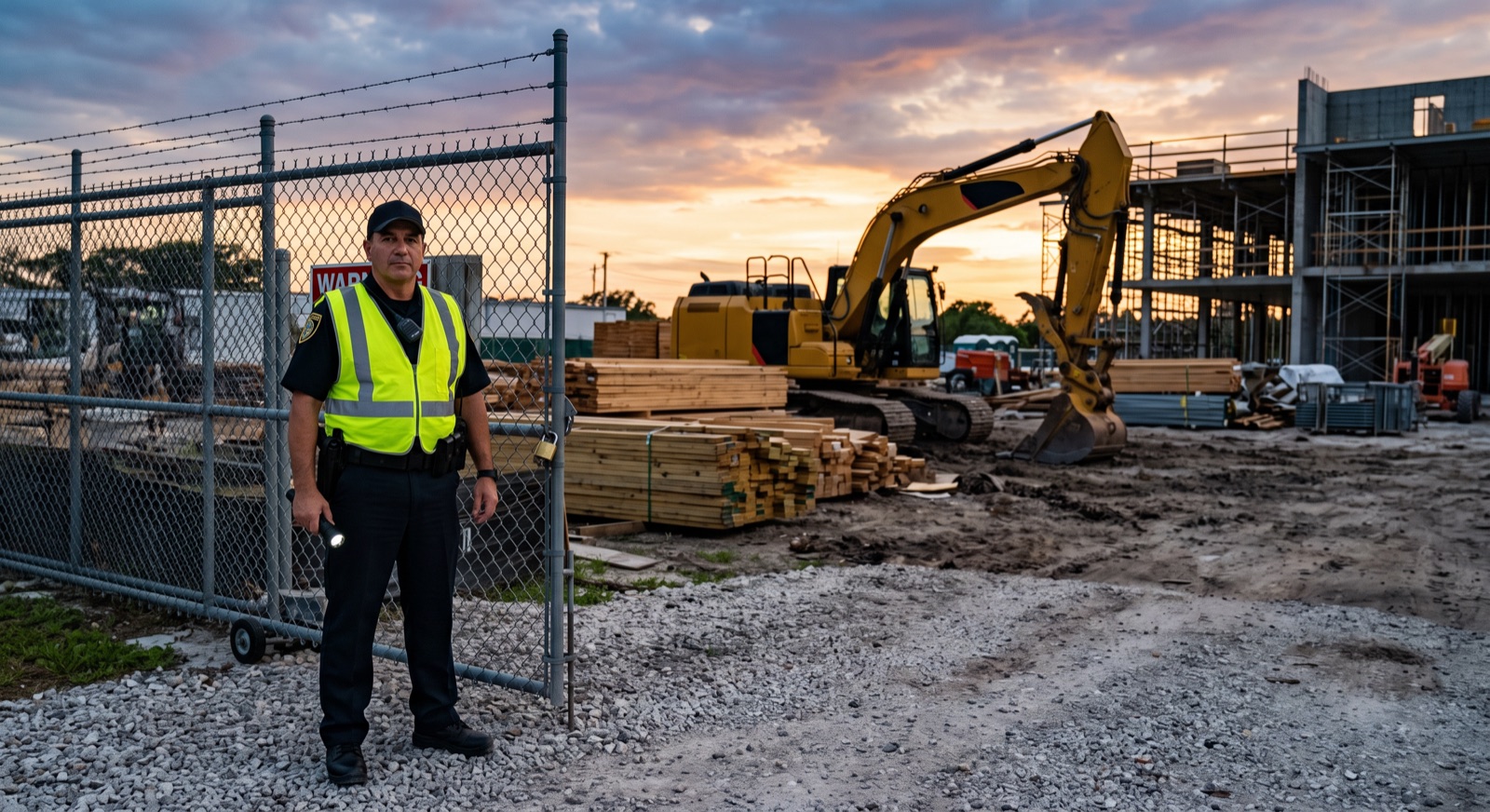
Ask a superintendent when things go missing from a job site and the answer is almost always the same: overnight, over a weekend, or during the gap between the last subcontractor leaving and the first one arriving. The fence is up, the gate is chained, and somehow a generator, a pallet of copper, or a trailer full of tools is gone by Monday morning.
Construction site security is less about one dramatic deterrent and more about closing the quiet gaps in a site's day. This guide walks through what a well-run security plan actually covers on a Tampa Bay job site, where the exposure tends to sit, and what to ask before you hire anyone to cover it.
Why Job Sites Are Hard to Protect
A construction site changes every week. Yesterday's open perimeter is today's framed wall, and next week's laydown yard sits in a different corner. Add a rotating cast of subcontractors, deliveries at odd hours, and expensive equipment parked outside, and you have a property that never stays the same long enough for a fixed security setup to keep up.
A few things make Florida sites specific:
- Weather changes the site overnight. After a storm, fencing gets knocked down, lighting fails, and materials get scattered. Sites are most exposed exactly when crews cannot get back in right away.
- Active sites are often open to the public on one side. Roadside frontage, adjacent businesses, and shared access drives mean more people near the fence line than on a closed industrial property.
- Hot work is common. Welding, cutting, and grinding create fire risk, and in some situations a fire watch is required. We cover that in our guide to Florida fire watch requirements.
None of this means a job site is a lost cause. It means a security plan has to be written for that specific project, not copied from the last one.
What Construction Site Security Actually Covers
When a general contractor asks what a guard service does on a site, the honest answer is a set of routines. A typical plan covers:
- Gate control during working hours. A log of every vehicle, delivery, and visitor on site. This is also the record you reach for when a question comes up about who was on site and when.
- Patrols during operating and non-operating hours. Foot and vehicle patrol across the site, with the route varied so it is not predictable.
- Perimeter and fence inspection. A check at the start of each shift for cut fencing, open gates, or anything that changed since the last walk.
- After-hours entrance control. Making sure the ways in and out are actually secured and stay that way.
- Watch over materials, equipment, and laydown yards. These areas are usually the first place a loss shows up.
- Office trailer protection. Trailers hold plans, records, and often keys, so some sites need coverage there around the clock.
- Same-shift incident reporting. A written report with photos to the superintendent, not a phone call the next morning.
The point of the list is not that every site needs every item. A steel erection project and an interior retail build-out have very different exposure. The plan should match the project.
Armed or Unarmed: How to Decide
This question comes up on almost every quote request. The answer depends on what is on site and what the risk actually looks like, not on which sounds more serious.
Unarmed officers are usually the right fit for gate control, visitor logging, and patrol on sites where the main goal is deterrence and documentation. Armed coverage is sometimes chosen for sites holding high-value materials or equipment, or where the project's insurer or owner requires it. In Florida, armed officers need the appropriate state licensing, which is worth confirming with any provider you are considering.
If a vendor pushes armed coverage without asking about your site, or refuses to discuss unarmed options, treat that as a signal to keep looking.
Plan the Coverage Around Your Schedule
The most common mistake we see is buying coverage for the wrong hours. A site that only has a guard during the workday is protected when it is already busy and exposed when it is empty.
A simple way to plan it:
- Map your exposure hours. List when crews are on site and when they are not, including weekends and holidays.
- List what is on the ground. Tools, fuel, copper, lumber, parked equipment, and anything that would delay the schedule if it disappeared.
- Identify every access point. Main gate, side gates, temporary openings, and any place a vehicle can pull up.
- Decide who gets called. A security plan is only as good as the escalation path: who the officer reaches first, and what happens if that person does not answer.
- Revisit it as the site changes. A plan written at groundbreaking will not fit the site at framing.
Coverage that scales up and down with the phases of a build usually costs less than a flat package that ignores them.
Fire Watch and Site Security Often Overlap
Hot work, impaired sprinkler systems, and temporary fire protection changes can all trigger fire watch requirements on an active site. When the same provider handles both, the officer already on your gate or patrol route can often cover the fire watch shift as well, and the reporting comes through one channel.
If your site has hot work scheduled, ask up front whether the provider can staff a fire watch and how the documentation is handled. It is easier to plan for it than to scramble on the day an inspector asks.
What to Ask Before You Hire a Site Security Provider
A short list of questions separates a serious provider from a generic one:
- Are they a licensed, insured Florida security agency? Ask for proof, not just a claim.
- Are the officers trained for construction environments? Site safety, PPE expectations, and how to work around active equipment matter.
- How is documentation handled? Shift logs, gate logs, and incident reports should be written and delivered the same shift.
- What happens when an officer calls off? A gate left uncovered is worse than no plan at all. Ask about dispatch and backup coverage.
- Will they write a plan for your site? A quote built from the site address, schedule, and what will be on the ground is a better sign than a flat hourly rate offered sight unseen.
- Who does the officer report to? They should answer to your site lead day to day, and know when to contact law enforcement or fire rescue.
About ESS Global
ESS Global is a licensed, insured Florida security agency providing construction site security and security guard services for commercial and government projects across Tampa Bay and the rest of Florida. Officers are trained in First Aid and CPR, with continuing training through ESS Academy, and every site starts with a written protection plan built around the project rather than a one-size package.
Get a Site Protection Plan
If you have a project coming up, or a site that has already had losses, the easiest first step is to send us the site address, the schedule, and what will be on the ground. We will come back with a plan and a quote. Request a quote or call ESS Global at 727-940-7926.
Open questions for review:
- The Florida Security Agency license number is not cited. The live site shows "B 1200075" while the school security draft lists "B12000275". Please confirm the correct number before any article cites it.
- No statistics are cited. The live construction page quotes a National Insurance Crime Bureau figure on annual theft losses, but I could not verify the source, so it is left out.
- "Protected sites since 2011" and named contractor clients from the live page are intentionally not reused (Section 4: no client names without written approval).
- Armed vs unarmed section stays general and does not state specific Florida licensing classes. Please confirm the wording is acceptable.
- Related live posts to cross-link once published: school security and fire watch are linked or referenced; consider adding the estate assessment post.