An estate security assessment in Tampa Bay is a structured survey of a property, the people who live and work on it, and the threats to both. If you own or manage a large home here, the security options in front of you are sold as separate products: cameras, a monitored alarm, a gate upgrade, a patrol, an officer at the entrance. An assessment ranks your risks before you buy any of that, so you spend on the biggest problem first. ESS Global is a Tarpon Springs security agency that performs threat and vulnerability assessments across Tampa Bay alongside its guard and executive protection services. Below is what the assessor looks at in each phase and what the final report contains. There is also a license check to run on any firm before you let it walk the property.
What an estate security assessment looks at first
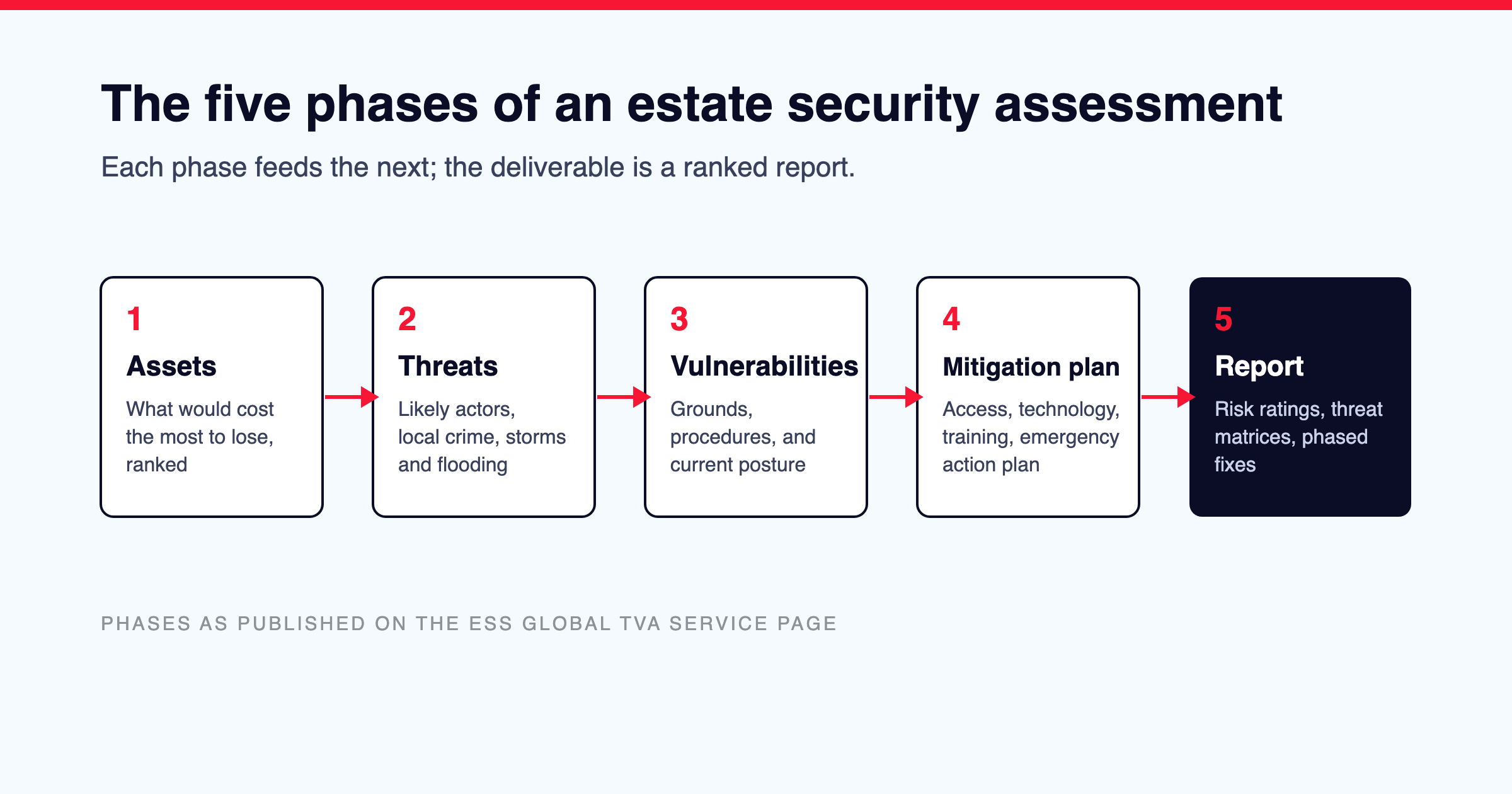
The first phase is an asset value assessment: a ranked list of what on the property would cost the most to lose. On an estate that list starts with people, meaning the family and everyone who works on the grounds, and it extends to the buildings and systems, and to the household’s paperwork and plans: schedules, travel arrangements, and financial documents. The assessor builds the rest of the assessment around this list.
The second phase is threat analysis: the assessor names the likely threat actors and the most dangerous things they could attempt. ESS builds that picture from open-source intelligence, law enforcement data, and what its assessors see on the ground. In Tampa Bay that includes crime rates for the surrounding area plus hurricane and flood exposure. ESS used those same sources on an assessment for a government technology facility in Florida, where the work also covered risk ratings for the people and property on site and integration planning with local law enforcement and emergency medical services.
Where the assessor looks for weaknesses
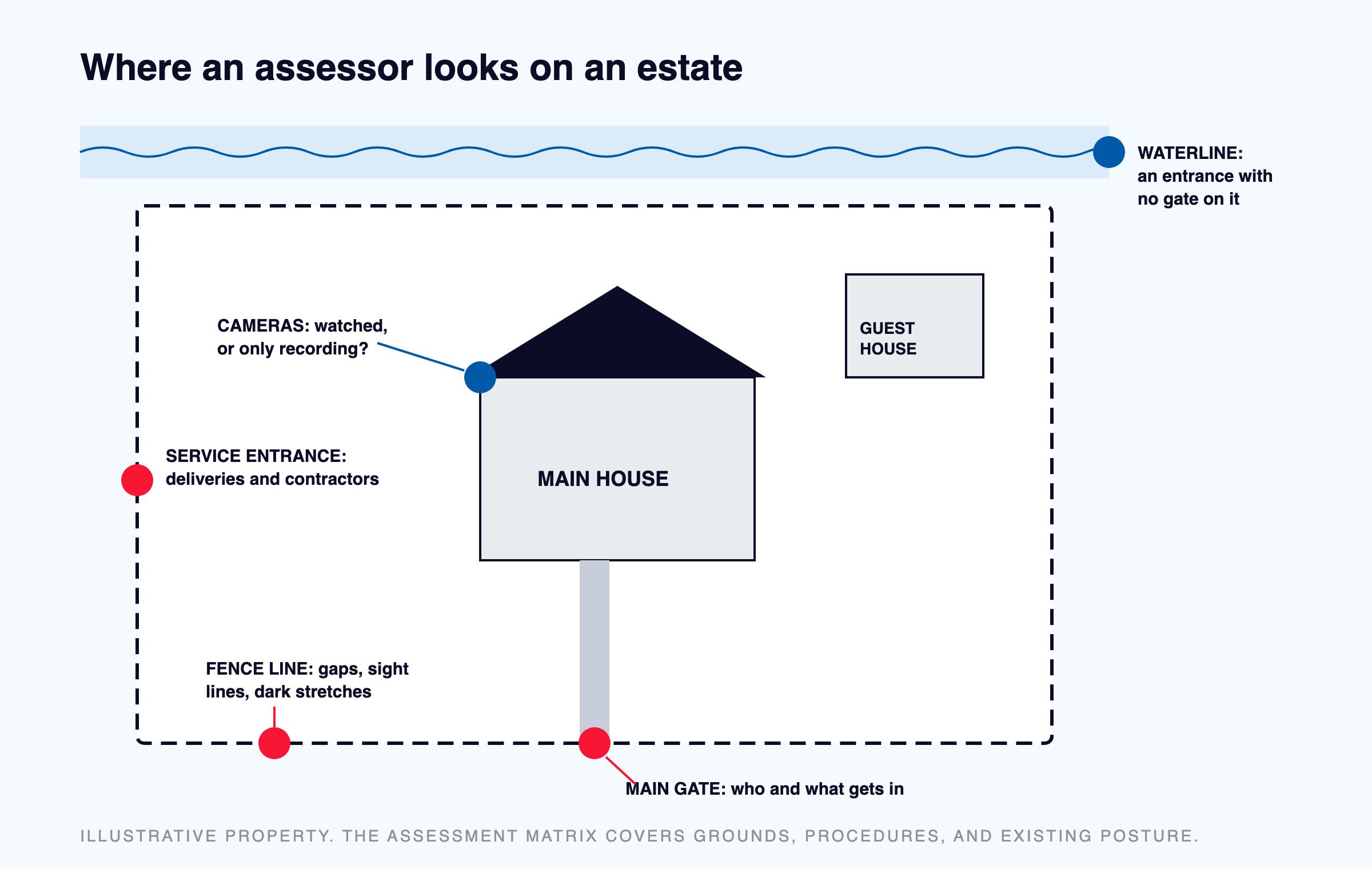
In the third phase the assessor works through a structured matrix, looking for weak points in three areas: the physical grounds, the operating procedures, and the existing security posture. On the grounds, that means the perimeter, the entrances, the sight lines, and the places where the property can be reached without being seen. Procedures cover the people on the property: who holds gate codes and keys, how deliveries and contractors get in, and what happens when a stranger rings the intercom. Posture means the security you already run: the cameras, the alarm, the lighting, and whether anyone watches the feeds or they only record.
The people doing this work at ESS are subject matter experts with more than 20 years of experience, and their backgrounds include U.S. State Department security service, law enforcement, and military training. The team page lists Jeffery Dick as the company’s threat and vulnerability assessment specialist. Each assessment is site-specific and shaped to the owner’s risk tolerance. ESS keeps the consultation and its findings confidential.
Inside the final report
In the fourth phase the assessor turns the findings into a mitigation plan for the property. ESS publishes what a plan can include:
- Access control upgrades: changes to who can get onto the property, and where.
- Technology recommendations: cameras, sensors, and communications equipment specified for the site.
- Training protocols: basic life support, trauma care, and active shooter response for the people on the property.
- An emergency action plan: written for the site and then practiced in drills.
- Covert armed protection: where the threat picture calls for it, drawn from the same pool of agents as ESS’s executive protection details.
The fifth phase is the report: a board-level document containing the findings, risk ratings, threat matrices, and recommended actions. For the Florida facility above, the deliverable was a security roadmap with phased implementation and executive protection integrated into it. When the plan calls for officers on the property, ESS staffs that from its own guard services, which cover private security contracts and residential communities with armed and unarmed officers.
Making the fixes the report recommends is a separate purchase. If you already know you want a monitored alarm and nothing else, an alarm company will sell you one directly and install it well. You will still not know what else on the property needs fixing first. If you can only pay for one of the two, our position is to pay for the assessment first.
Check the license before the walkthrough
Florida licenses this industry under Chapter 493 of the Florida Statutes, and every license mentioned below is publicly searchable. A business that furnishes security services for pay must hold a Class B security agency license under s. 493.6301(1). The number is usually printed on the firm’s own site, and ESS Global’s, license B12000275, is in the footer. The individual officers need a Class D license under s. 493.6301(5), and any officer armed on your property needs a Class G firearms license on top of it under s. 493.6301(6). A Class G license requires at least 28 hours of range and classroom training under s. 493.6105. The Florida Department of Agriculture and Consumer Services runs the lookup, with one search page for agencies and schools and another for individual officers, so ask for the names of the officers assigned to your property and run them through the individual search.
The state also licenses the training: a Class D officer must complete at least 40 hours of professional training at a department-licensed school under s. 493.6303(4)(a), and the schools hold Class DS licenses under s. 493.6301(7). ESS runs one of those schools, ESS Academy in Tarpon Springs, under school license DS1400022, and the Academy lists more than 2,240 graduates. Its courses include the state’s 28-hour Class G firearms training and the trauma care training that mitigation plans recommend, and ESS trains its own officers there before assigning them to client properties.
Getting one scheduled
The first step is a consultation: call 727-940-7926 or write to info@essglobalcorp.com. Have three things ready: the property address, a list of the security you already have, and whatever prompted the call. For properties inside an association, ESS management also attends board and committee meetings. The quote is free, and the full description of the assessment service is on the threat and vulnerability assessment page.